Snapping Turtle Goes to War
We're back with our friend Snapping Turtle this week. This particular story is told twice, and there's a third Snapping Turtle story that we may get to another time. Snapping Turtle Goes to War is told by John Penesi, Chief of the Fort William Ojibwe. Snapping Turtle on the Warpath is told by Wasagunackank (He-that-leaves-the-Imprint-of-his-Foot-shining-in-the-Snow) who was an old man at the time that these stories were collected, living in Pelican Lake near the Bois Fort Reservation in Minnesota. Wasagunackank adds some extra details to the story but it is fundamentally the same. Imagine being an old man in 1906, the shifts and changes he saw over the course of his lifetime.
There is also a story of the same name from the Lakota about a snapping turtle who returns from hunting to find that an enemy tribe has stolen his wife and he goes to rescue her. These Ojibwe stories don't have anything about a wife, stolen or otherwise. We are used to Disney and anthropomorphized stories about animals, teacups, and whatnot being alive and either helping or hindering the heroes, but for many peoples these beings were alive in their own right. They were animate in ways that don't register to us, possibly because we aren't looking for it. With animacy comes some kind of organized life, some kind of social activity that makes sense for trees, for example, who we now know communicate and see although it isn't anything like the ways that we communicate or see.
I want you to hold that in your mind while we wonder about this story of a Snapping Turtle going to war. Not as an imaginative tale, but as a legend that remembers other ways of living. A story from a time when animals had their own forms of governance and structure without human interference. Forms of governance and structure that persist despite our interference.
Turkish/British author Elif Shafak reminds us that legends are just echoes of things that history has forgotten.
I was reading stories about The Mystic Rite contained in part two of the archive where we find these Snapping Turtle stories and in the second of three stories (these are credited to Wasagunackank but footnotes acknowledge that Midaasoganzh may have told them as well) there is a gathering that includes Snapping Turtle and many others. A man called Mighty One decrees how things will be in the future, telling Snapping Turtle that he would play a leading role in giving knowledge to those who wish to be skilled in soothsaying. A soothsayer is one who can predict the future, who knows what is to come, and somehow Snapping Turtle is the one who, within the context of what is translated as the Mystic Rite, will play a leading role in giving this knowledge or skill to the people who wish it. You'll recall that in our last story, Snapping Turtle went to war against the Caddice Fly village, he twice visited a shake tent with the son of the Caddice Fly chief. Shake tent is where people gain knowledge from spirits, knowlege about things like what's going to happen in the future.
Although soothsaying is associated with predicting the future or acting as a prophet the english word has its roots in speaking truth and prophets are, often, those who speak truth into key moments. By speaking truth to power, we can change or create the future. Snapping Turtle is also the turtle most often associated with the story of creation, if you are familiar with the term "Turtle Island" it is generally told that it was a Snapping Turtle who agreed to have the handful of dirt spread on her back. In the spring as they come out of hibernation it is not unusual to see snapping turtles walking around looking like miniature islands, grasses and moss growing on their backs.
On to our story.
This time Snapping Turtle's beef is with humans. Having returned home after his adventure to a shake tent and the Thunder Beings with the young Caddice Fly, Snapping Turtle is all alone. He climbs up a hill and calls out "with whom will I go when I set out for war?"
First up in Penisi's story is a man, described only as a voice but when asked to show Snapping Turtle what he's got is revealed to be a man brandishing a club. There's some trash talking back and forth about who is going to die and the man gives up and goes home.
Snapping Turtle calls out again and this time a whole bunch of Painted Turtles, having learned nothing from the debacle with the Caddice Fly town, answer that they will go with him. He asks them to show him what they've got and they all pull into their shells and look like stones. This inexplicably impresses Snapping Turtle and off they go. The next morning one of the turtles sings a song about a dream he had in which they are prophesied an evil fate. WTF says Snapping Turtle, this kind of thing being bad for morale, and cuts off his head.
He should have listened. They should have listened.
So they all head towards the town and Snapping Turtle tells them to hang tight because he's going do some recon and see what's what. Snapping Turtle and one of the turtles go into the town and each of them cuts off somebody's head, hiding the heads in their garments and themselves under a wooden bowl. They are caught of course and Snapping Turtle is taken captive, the painted turtle getting away clean.
While the people were trying to decide what to do with Snapping Turtle the painted turtles, being made aware of their leader's predicament, come into the village to rescue their friend and, when they retreat into their shells, the women pick them up, put them in bags, and throw a feast. Painted turtles are edible, but they are also small and don't have much meat so you'll need a lot of them and before you have your own feast best check your local wildlife laws.
The villagers decide to throw Snapping Turtle into the fire and he says wait no! Might burn up the children with all the smoke I'll make. Good point, good point the people agree and decide to throw him into the hot water. Wait no! I might burn up the children! Ok then, they decide to just throw him into the water and Snapping Turtle agrees that this is the best course of action. The footnote says that it's usual to have the Snapping Turtle saying "oh noes" which he does in the version told by Wasagunackank.

Off he goes into the water which is exactly where Snapping Turtle wants to be. Thinking he is dead, a woman comes down to the water to add Snapping Turtle to the feast. He kills her instead, chopping off her head and then singing an obnoxious song about how he's the one who killed the woman.
Otter, being very good at swimming agrees to dive into the water and get that rascally turtle only to have his penis bitten. Snapping Turtle says, through gritted teeth, that he won't let go until a thunder storm comes up. There is a thunder storm, he lets go, and they both go their separate ways. When Snapping Turtle gets home the gizzard of a ruffed grouse is hanging aloft, which we now know is code for Pay Attention.
Wasagunackank's version differs in a few ways. The first to respond to Snapping Turtle's calls are a Moose and a Bear, both of whom are rejected for strategic reasons. Snapping Turtle enters the village alone rather than with a comrade and he kills two children whose heads he turns into war clubs. He does eventually bite Otter's penis and clearly calls for the Thunders, rather than the more vague thunderstorms, before he agrees to let go .. which sounds to me very much like "make me" knowing full well that it will take beings as powerful as Thunderbirds to make him. There are no ruffed grouse gizzards in this version.
I'm reading Vine Deloria's The Metaphysics of Modern Existence and he makes a comment that nature has its own history in which we are very recent arrivals. In terms of western Christianity and the cultures that emerged from it, few are wondering about God's activity in nature, those (citing Ian Barbour) "long stretches of cosmic time before man's appearance." It is all well and good to say that the Bible and theology are concerned with humanity's relationship with our creator, but isn't that long stretch of cosmic time worth wondering about? When you meet somebody new, you want to meet their parents and friends as well, the people who knew that person before you did in part because of the additional context they provide. How these beings interact with each other and the cosmos in general matters, particularly when you consider that for the Anishinaabeg at least, part of humanity's purpose is to maintain balance between this world and spirit world. Nanaboozho having divested himself of this responsibility, possibly because he's not very good at it.
These Anishinaabe stories concerning animals give us a glimpse of a world, which we may or may not inhabit yet, in which other beings have meetings and conflicts, relationships with the same spirits and ceremonies that we eventually have. Those things give us imporant information about how we are to live alongside these beings whose histories extend back far beyond our own. They teach us how to live with this world instead of just on top of it, extracting whatever meets our own needs.
The first story of Snapping Turtle going to war has nothing to do with humans, we may not even exist in that story. Just because Pinesi told this one next doesn't mean that it happened right after. Eons could have passed during which time we were created.
I'm curious about a bunch of stuff in this story, like the differences between them. Pinesi's seems to be a more sanitized version, a sensitivity perhaps to how people may interpret Snapping Turtle not only killing children but skinning their heads and putting them on sticks to wave at the villagers. It seems deliberate because he leaves in "what about the children?" which makes no sense until you read the other story. It's awfully hard not to make moral judgements about this being who is meant to be our helper in the shake tent, whose relative lies beneath our feet.
I hate it when people make excuses with the stories of genocide in the Bible by the way. It was the times, things were different, blah blah blah. Making excuses for the Hebrews entering Canaan and slaughtering men, women, children, and animals. The trouble with that strategy is that these were people who existed, their descendants making the same excuses to justify a contemporary genocide. Israeli leadership openly refers to Palestinians as "Amalekites," one of the people designated for extermination in the conquest of Canaan and far too many people let them make those excuses. Many Christians excuse it because they have a theology in which they aren't allowed to criticize Israel and western politicians excuse it because as Dan points out in this video, they did exactly the same thing to Indigenous peoples here.
Great video from Dan McClellan taking down the excuses for God ordering genocide
So what do we do with Snapping Turtle. Is he Keyser Söze? A powerful being made powerful by his willingness to do what others will not? Twice he leads other beings into battle and twice he alone survives. He doesn't coerce them into following him, he asks for volunteers and they come. There is no indication that there were any consequences for not joining him and in both stories he actually turns away the first who volunteer. He tricks the people into doing the one thing that won't harm him which is pretty clever and reveals how little the people knew about the being they were dealing with. We rarely know as much as we think we do when it comes to spirits.
It's the killing of children in Wasagunackank's version that I struggle with reconciling. Skinning their heads and putting them on sticks. So let's look at that more closely.
The women have thrown the painted turtles into sacks and Snapping Turtle rushes into a lodge where he sees some children. He breaks their necks and tucks their heads by his groin, which I read as similar to carrying the young Caddice Fly and the young Thunderbird in his armpit in the previous story. It places them inside his shell so that he can move easily. He sees their father and is anxious to get out of the lodge but the man captures him and ties him to a post. One man says he will kill him with a club or an axe and Snapping Turtle says good luck, you'll break your axes.
Now the comments from the earlier story about burning up the children make sense. He has their heads inside his shell so throwing him into the fire or into boiling water would destroy them as well. We haven't talked about the Rolling Head story, but the people in this story may have been familiar with it and the early listeners to it certainly would have been.
But this isn't a Rolling Head story, which is a story of death and vengeance or perhaps judgement on the part of the rolling head against those who wronged it. This may be a coup stick story. Nanaboozho did this in spirit world, killed his brother and put the skin of his head on a stick. You'll recall that Nokomis was not impressed by this, asking him "what have you done." A coup stick is about touching the enemy with a special stick or lance and coming away unscathed. It shows them what you could have done in the hopes that they will admit defeat and the two sides will avoid a whole lot of bloodshed. In order for this to work the enemy has to know what you've done, you may draw blood or take a trophy of some kind and the children's heads would certainly be a trophy demonstrating what what Snapping Turtle is capable of and possibly lead to the humans standing down. We never do find out why Snapping Turtle went to war against the humans
I don't know why Pinesi left this out of his version of the story. Perhaps he knew that by the early 1900's we were losing our capacity to wonder without judgement, losing our willingness to imagine worlds that did not revolve around us, and he wanted to protect the story so that it would continue to be told. There are surely other things within these conflicts Snapping Turtle provokes that we could learn from, Pinese's version does have the prompt of the ruffed grouse cueing us to important knowledge. It reminds me of a practice that some elders have, holding back in order to protect knowledge from those who don't know how to use it.
It's not always about us.
Baamaapii
Katabasis by RF Kuang is another dark academe book, like her earlier work Babel but this time she's on about magic instead of language. Two PhD students journey to hell to rescue their horrid advisor so that he can get them through their dissertations and into the world of post-PhD success that would otherwise elude them. I really enjoyed this, although I'm getting tired of Kuang's unlikable main characters and am beginning to suspect she doesn't like herself very much. I could write a whole blog about that, but I won't. I did like Katabasis more for the world she creates and the insights about what hell and the various sins are, and I liked some of the other characters. The river Lethe features heavily in the book. In Greek mythology Lethe is one of the five rivers of the underworld and possesses the power to completely erase the memories of the dead so they can be reincarnated. I remember as a kid thinking that was unfair, how could I right wrongs if I couldn't remember them? But memory is it's own kind of curse, as discovered by Alice in this book, so perhaps that's a kindness. Reincarnation, which I'm not sold on by the way, doesn't teach that we need to right specific wrongs anyway, just live well. Keep trying. Imagine the hell of having the memories of all those lives in your head anyway.
The River Lethe was my favourite character. In Becoming Kin: An Indigenous Call to Unforgetting the Past and Reimagining Our Future I use the term "unforgetting" to call us to a better set of relationships because I liked the way that the word made me feel even if I didn't understand it very well, so I'm always happy to find something that helps me understand it better. Lethe is forgetfulness, alethia, a related word, means truth. Not really the opposite, just connected words. The river uses forgetting to prepare us for rebirth, which is exactly what settler colonialism does to us doesn't it. It erases memories and identities so that we are all reborn as Canadians or Americans or what have you. The erasure of settler colonialism is a much different concept from the Māori teaching walking backwards into the future or Sankofa, a West African teaching to "go back and get it" in the sense of learning from the past.
While we're thinking about things like rivers being a character, in The Island of Missing Trees Elif Shafak gives us a character who is a fig tree but unlike the Lethe, this tree has sentience just as the water drop did in her book There are Rivers in the Sky: A Novel. Shafak is British and Turkish, I include her here not only because her books are beautifully written but because I want to remind us that it isn't only people who are Indigenous to the so-called Americas who understand the world to be filled with spiritual and sentient beings who are not human. This is what I am on about in Bad Indians Book Club, why it is so important to read a range of marginalized writers. Stuck in our siloes with nothing but the rebirth of settler colonialism and our own fractured memories we begin to think that we're the only ones who know these things. So much better to see how much we have in common and work together.
To whoever it was that recommended this book to me, thankyou! I bought it when you recommended it, but it's languished in my tbr pile ever since, then yesterday while I was looking for a new book to read I found it and turned out it was the perfect place to go after I finished Kuang's book.

Order your copy of Bad Indians Book Club today in the US through Bookshop.org, and in Canada: Indigenous owned GoodMinds, as well as indie books which will show you which local bookstore has it in stock. Get it wherever you get your books.
Podcasts and Interviews!
Missing Witches fundraising panel
Science and Nonduality network Sounds of Sand podcast
The Radical Sacred
Missing Witches Part 1 and Part 2
Turning Pages
A Matter of Faith: A Presby Podcast
CBC's The Next Chapter
New York Society Library
Shawn Breathes Books
Book reviews!
In Windspeaker News
Featured by Poets and Writers as one of "best books for writers"
Featured by the Library Journal's reading list for Native American history month
Featured by Goodreads for Native American Heritage Month
Featured by Powell's Books for Native American Heritage Month
The Miramichi Reacher
I've Read This
Pickle Me This
Foreword
Reading Our Shelves
Red Pop News
On Our Radar: 49th Shelf
Ms Magazine's top 25
Summer Must Reads Toronto Star
CBC Books 45 Canadian nonfiction books to read this fall
One of the 100 Best Books of 2025 from Hill Times
My list of "must read books" for CBC on TRC Day, Sep 30 2025
An excerpt published by Baptist News Online.
Do you want me to zoom into your local bookstore or bookclub? Talk with you on your podcast? I can do that. patty.krawec@gmail.com For larger professional settings you can email Rob Firing at rob@transatlanticagency.com
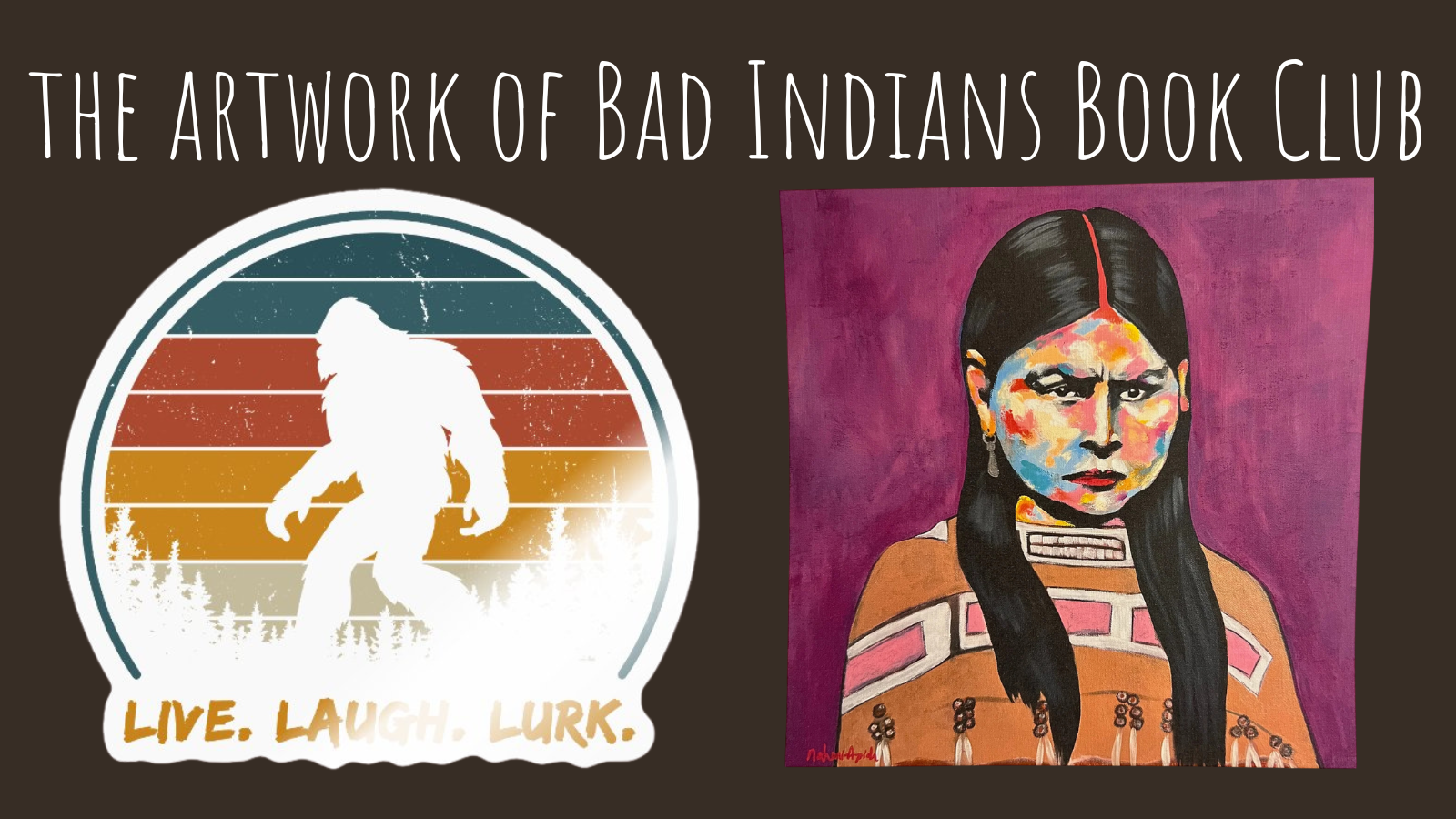
Want to add Bad Indians Book Club merch to your life? Get your Live Laugh Lurk on at Johnnie Jae's shop where she sells tshirts, stickers, tote bags and so much more. And that cover art by J NiCole Hatfield is stunning isn't it? She sells prints, cards, and more on her website.

And don't forget to join up with the Nii'kinaaganaa Foundation. Every month we collect funds from people living on Indigenous land and redistribute them to Indigenous people and organzers. You can find out more information on the website which is now powered by ghost, which means that you can become a subscriber there just like you are here! You can sign up on the website to be a monthly donor or make a one-time donation right here.