Snapping Turtle And the Caddice-Fly

"The world emerges from abstraction into reality."
Chanda Prescod-Weinstein, The Edge of Space-Time: Particles, Poetry and the Cosmic Dream Boogie
Today's story is ostensibly about Snapping Turtles and Caddisflies (aka sand flies), both of which live in the Niagara Region as well as the land and waters north of Thunder Bay where these stories were documented. But it's also about emergent worlds and the beings who travel between them.
We live in a rural area and my neighbours and I all have ponds because we're built in a wetland area and the ponds give rainwater and snowmelt an alternative to creating lakes in our yards where we may not want them. The land here is clay so when the rain falls it tends to just sit there. We have (loosely speaking) a huge snapping turtle who goes back and forth between two of the ponds and we've gotten relatively close to him, but not very. He clearly hates us and those jaws look like they could do some real damage. There have been times when we've seen him swimming in the pond, not really seeing him, just a sudden movement of water indicating something big is below the surface. We see the reaction of the water and make some assumptions about what is causing it.
Among other things, snapping turtles eat caddisfly larvae. They don't eat the flies themselves, trout do that, but they will eat the larvae. Caddisflies are related to mayflies and dragonflies as well as the moths and butterflies that have scales on their wings. Their larvae are acquatic. Full grown caddisflies, like mayflies, dragonflies, moths, and butterflies, are not. Snapping turtles are amphibious, living in both water and land. They also look like dinosaurs. Snapping turtles actually existed alongside the dinosaurs and survived the extinction event. Both caddisflies and snapping turtles were around in the Paleolithic too, so they would hold ancient stories and knowledge that predate human existence. As a final note, caddisflies live about one year from larvae to adult. Snapping turtles live between 30-70 years, with some making it past 100.

Introducing Tarot Time. This is content for paid subscribers, like new subscribers Karen, Terri, and Carla. Thankyou!
Subscribers can ask questions and while this wouldn't be a conventional reading, readings require a conversation between the interpreter and the asker, the cards I pull in response to the question will offer a story that everyone can find something in. Kind of like the stories we wonder about in the main blog.
Snapping-Turtle and Caddice-Fly
Told to William Jones between 1903 and 1905 by John Penesi, chief of the Fort William Ojibwe. I am paraphrasing the original story which you can read in complete form by clicking on the title. The snow is long gone so we'll be reading stories from Volume 2 which take place in this world, and will return to Bebemosed (Nana**zho's summer name) and spirit world shenanigans in the winter.
Ok, so back in the long ago there were turtle villages. Every kind of turtle there was had it's own village: soft shelled, snapping, painted, and musk-turtle. The snapping turtle was their chief and he announced that he was going to go to war against the Caddice Fly. Then we get three pieces of information: He made ready to go to war. He greatly conjured for magic power. And he was proud.
With a jaunty little song about being the leader of a war party, he started away with the youth from the other towns alongside him. They got to the Caddice Fly town and, all parties being armed with war clubs, things got started. These particular Caddice Flies and Turtles also had the ability to breathe life and healing back into their fallen comrades which prolonged the battle well through the morning but eventually the turtles couldn't keep up and Snapping Turtle alone survived, taken as a captive.
He was allowed to walk around their town under guard, which began to chafe a bit so he made an agreement that if they would let him go he would stay in the company of the Caddice Fly chief's son. I don't understand this agreement at all but the list of things I don't understand is rather long so we'll just go with it. Maybe it was just to keep him on good behaviour, the presence of the son would ensure that Snapping Turtle didn't raise another army? Doesn't seem particularly effective to me but what do I know about turtle/fly politics.
They go off on their journey and hearing something fall, they notice a conjuring lodge on the other shore. The youth wanted to go there so that's what they did. Upon arrival, they went inside the conjuring tent which was swaying and where there were quite a lot of people talking and singing about the sky and the winds. It was a little crowded in there, so after a while the turtle and the youth went back outside. The youth then noticed a mountain and birds, he wanted to go there too so that's what they did and the youth brought back one of the young birds.
Upon their return the youth saw that the conjuring lodge was still swaying and he wondered if there ever a time that this lodge would be still. Never, said Snapping Turtle. Not since the beginning of the world and it will never be still as long as the world lasts. Only when the entire sky is calm, which seems like a very pretty way of saying forever.
It was time to go home, so they left the tent again and prepared to cross the lake. Caddice-Flies don't fly very far, staying close to home and hiding in the vegetation near water so you may be wondering how they got across the lake and how they're going to get back now that they've also got a young bird. And, since I've told you that we've only seen the turtle swimming by the disturbance made in the water we know that Snapping Turtle is not a surface swimmer like the iguanas I saw in the Galapagos. It's clever really, he carries the Caddice Fly, and now a bird as well, in his armpit which would put them inside of his shell. Just as they are getting near the shore Snapping Turtle remembers all the youth who followed him to war and are now dead, so he forsakes his promise to the Caddice Fly chief tossing the Caddice Fly youth and the bird into the water before going off in another direction.
They, the Caddice Fly youth and the bird, made their way to shore, bedraggled and wet, and dried themselves by the fire. The youth and his father became very fond of this young bird ... right up to when the thunderstorms hit. Straight over where the young bird was came the roar of the Thunderers that had come to see their young. Having done so, back home they went.
And so, after they had gone the gizzard of the ruffed grouse hung aloft.
There's that ruffed grouse gizzard, alerting us to something very important about this story, reminding us that there is more than meets the eye. As with last week's story about Ottawa Woman, these character choices that the storyteller makes are important, and the more I reflect on it the more this two-part story (the conflict followed by the journey to the shaking tent and the Thunderbirds) reminds me of the David Lynch film Mulholland Drive which has two somewhat distinct stories and attempts to make sense of them in any linear way falls flat.
Before we consider the first half of the story, let's jump to the second part where our friends encounter the conjuring tent and the Thunderbirds.
In the shaking tent the medicine person is making direct contact with spirit and then interpreting what they learn for the people who have come with questions or needs. The shaking of the tent itself indicates the presence of spirits so when the youth asks if the tent will ever stop shaking, he is in effect asking if the spirits will ever leave and Snapping Turtle tells him that won't happen. It has been shaking since the beginning of this world and will continue shaking until there is no more wind in the sky. This is not true of all shaking tents, they are set up for a purpose and then taken down. This tent is different.
The shaking tent is not a thing to be entered into lightly, as with Mordor, one does not simply walk into it and the Snapping Turtle would know this. Although, I'm thinking about the boundaries laid out for Anishinaabe participation in this ceremony. Maybe beings whose roots are as ancient as Snapping Turtle and Caddice Fly don't need those boundaries to keep themselves safe. Who knows, maybe Snapping Turtle was there and we don't need to cite the Deep Magic to him.
Thunderbirds played a role in the creation of Anishinaabe. Bebamosed and his brother were creating beings for this world and despite their constant tweaks and adjustments, the beings they made persistently wandered off. In exasperation they asked the Thunderbirds to shape the world with their wings to keep the people contained, and that did it. Anishinaabe came into existence and we stayed put, mostly, contained by the mountains near Thunder Bay on one side and the Laurentians in what is now western Quebec on the other. Thunderbirds nest in these mountains and as we saw in Blue Garter, they have tremendous power. These beings don't need a special ceremony, with all the preparation that entails, to access a bridge or portal between worlds. They are one. And Snapping Turtle tucked one of their babies under his armpit for a swim across the lake.
I'm curious about these two bridges we're introduced to: the tent that never stops shaking and the Thunderbirds and I noticed them in a particular way because I'm still reading Chanda Prescod-Weinstein's book The Edge of Space-Time: Particles, Poetry, and the Cosmic Dream Boogie where I learned about something called Hilbert space.
Hilbert space is a different concept of space, one that became necessary to explain quantum experiments about spin and wave and honestly I've read this part of the book (around page 153) a few times and particles aren't the only things spinning. It makes my brain hurt but the part that did stick is that things that happen in Hilbert space will always be imaginary (as in imaginary numbers) but they have real-world consquences. Hilbert space is mathematical. It doesn't exist physically. "Somehow," Prescod-Weinstein writes at the bottom of page 137, "the world emerges from abstraction into reality."
Things happening in one realm have material consequences in the physical realm. Bebamosed kills his brothers as well as the Giant Toad Woman in one realm and Ottawa Woman gives birth to birds, game animals, and fish in this one.
I'm not the only person to notice that Anishinaabe stories and thought contain many of the same ideas about the way the universe(s) operate as quantum physics proposes and describes. In a podcast conversation that included Prescod-Weinstein, Ben Krawec noted that Lawrence Gross makes this point in chapter four of his book Anishinaabe Ways of Knowing and Being. Gross writes that the processes at work in quantum mechanics match the worldview of the Anishinaabe and he goes on to demonstrate this through the grammar structure of our language which is oriented around processes rather than things. Leroy Littlebear, a Blackfoot scholar, also writes about the similarities between Blackfoot metaphysical thought and quantum physics as did Lakota scholar Vine Deloria Jr who co-authored a paper on this with Daniel R. Wildcat (Yuchi, Muscogee) and so many others.
Our stories teach us to think about processes rather than things.
Our stories teach us that our world emerged from abstraction (spirit) into reality.
What was Snapping Turtle up to taking this young Caddice-Fly to the places and beings where the worlds emerge from abstraction into reality? Because that's what he did. He knew what he was doing when he said he wanted to leave and was willing to bring the chief's son with him. He knew that he was headed towards the shaking tent and that young beings are innately curious. And what, if any, are the consequences for taking a young Thunderbird from its home into the Caddice-Fly home? What happened after the Thunderbirds decided their offspring (and the Caddice-Fly community) was safe? Because Blue Garter's parents did not demonstrate the same kind of confidence, they were very concerned about what Blue Garter might do and rightly so.
It's an interesting contrast, the doomed war at the beginning of the story and then the journey to the shaking tent and Thunderbirds.
Now let's think about that doomed war and who was fighting it.
When I wrote the first draft of this reflection I focused on the action taking place, and that's valid because there's a lot there about ego and the risks of seeking power but the more I thought about it the more I thought about who these beings were, how they live, and how that connects with worlds emerging from abstraction into reality.
Snapping Turtles are amphibious, they live in land and water crossing boundaries in ways we cannot and for many Indigenous peoples amphibians often represented powerful or significant spirit beings for that reason. Caddisflies are not amphibious, but they do start in water, undergo a transformation, and then live on land moving through the air. Both of these beings cross over from one world into another and back again much like the bridge that is the shaking tent or beings like the Thunderbirds. We can live on top of water or swim under it with snorkel or scuba gear. We can strap on a motor or a wing and fly through the air. We need that special equipment to access air and water just like we need special items to access that abstract world from which ours emerged. We need ceremonies and helpers and sacred items set aside for that purpose. And we need to take these things seriously, that doomed conflict showing us what happens when you operate from ego and seek power.
Kind of funny that I got here because of a David Lynch movie that makes no sense if you insist on a conventional storytelling lens. But that's what surrealism does. It helps us shake loose of conventional patterns and opens us to other possibilities. Keep wondering.
baamaapii
We don't know most things. Kelly Hayes talked with Chanda Prescod-Weinstein about her book, The Edge of Space-Time: Particles, Poetry, and the Cosmic Dream Boogie. This is from Kelly's newsletter, Organizing My Thoughts, rather than her podcast.
The novella Flatland was written in 1884 by Edwin Abbott Abbott. Intended to as a satire on Victorian society and the English caste system, it is also an interesting bit of geometry as beings from 1, 2, and 3 dimensional worlds attempt communication with each other along with the theoretical possiblity of a fourth dimension.
The different life-spans of the Snapping Turtle and the Caddice-Fly reminded me of Dragon's Egg by Robert L. Forward. It is a very cool science fiction story about a world where the Cheela, beings the size of a sesame seed, live at an exponentially faster rate than humans. Their entire civilization goes from the advent of agriculture to space travel over the course of human months. Humans observe this, and while they can't have real time communication with the Cheela, generations pass between messages, a relationship does develop.
I know I've mentioned it before but Anishinaabe Ways of Knowing and Being by Lawrence K. Gross is such a good book if you are in any way interested in how our stories and ceremonies invite us to think about ourselves and the world around us.
This one is in my tbr pile. Vine Deloria's The Metaphysics of Modern Existence tests the differences and connections between Indigeous ways of thinking and those of the Western world.
And if you are interested in the Indigenous Paleolithic of the Western Hemisphere this book by Cree-Metis professor Paulette Steeves takes us into deep time, not as far as Prescod-Weinstein perhaps but far enough to learn about the world our distant ancestors inhabited and the animals they shared it with.

Order your copy of Bad Indians Book Club today in the US through Bookshop.org, and in Canada: Indigenous owned GoodMinds, as well as indie books which will show you which local bookstore has it in stock. Get it wherever you get your books.
Podcasts and Interviews!
Science and Nonduality network Sounds of Sand podcast
The Radical Sacred
Missing Witches Part 1 and Part 2
Turning Pages
A Matter of Faith: A Presby Podcast
CBC's The Next Chapter
New York Society Library
Shawn Breathes Books
Book reviews!
In Windspeaker News
Featured by Poets and Writers as one of "best books for writers"
Featured by the Library Journal's reading list for Native American history month
Featured by Goodreads for Native American Heritage Month
Featured by Powell's Books for Native American Heritage Month
The Miramichi Reacher
I've Read This
Pickle Me This
Foreword
Reading Our Shelves
Red Pop News
On Our Radar: 49th Shelf
Ms Magazine's top 25
Summer Must Reads Toronto Star
CBC Books 45 Canadian nonfiction books to read this fall
One of the 100 Best Books of 2025 from Hill Times
My list of "must read books" for CBC on TRC Day, Sep 30 2025
An excerpt published by Baptist News Online.
Do you want me to zoom into your local bookstore or bookclub? Talk with you on your podcast? I can do that. patty.krawec@gmail.com For larger professional settings you can email Rob Firing at rob@transatlanticagency.com
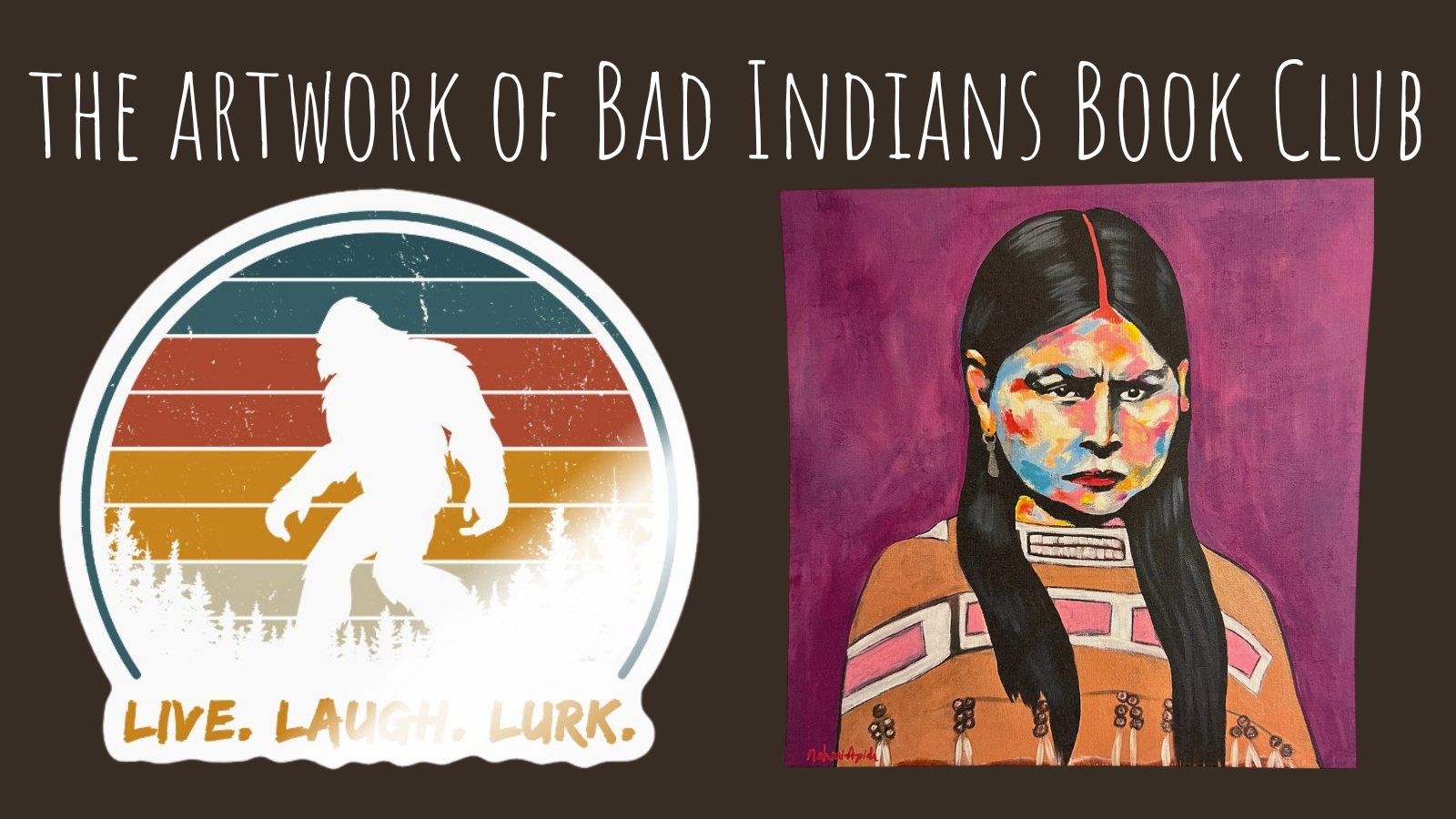
Want to add Bad Indians Book Club merch to your life? Get your Live Laugh Lurk on at Johnnie Jae's shop where she sells tshirts, stickers, tote bags and so much more. And that cover art by J NiCole Hatfield is stunning isn't it? She sells prints, cards, and more on her website.

And don't forget to join up with the Nii'kinaaganaa Foundation. Every month we collect funds from people living on Indigenous land and redistribute them to Indigenous people and organzers. You can find out more information on the website which is now powered by ghost, which means that you can become a subscriber there just like you are here! You can sign up on the website to be a monthly donor or make a one-time donation right here.