Odawa Woman
Every fall, while the leaves are putting on their own spectacular show, musicians and those who love to listen to them converge on a small island attached to the north coast of Nova Scotia by a two-lane causeway. Over the years I have enjoyed the Celtic Colours music festival on Cape Breton many times, most recently in 2024 when Carlos Nùñez headlined the final night's concert and reminded us all just how broad and diverse the contemporary Celtic world is. We tend to think of the typical Celtic nations: Ireland, Scotland, Wales, Brittany (part of France), Cornwall (part of the UK) and the Isle of Man which is its own thing. But the Celts, who emerged in western Europe millennia ago and migrated in all directions, also left colonies in places like Galacia in Spain where Carlos is from as well as more recent settlements in the New World where they formed communities in places like Cape Breton and Boston. Places where they developed unique cultures that are an amalgam of their Celtic roots and the new lands they called home.
The "Brittany Ferries Anthem" composed and directed by Carlos Nùñez. It is a brilliant piece of marketing: the ferries connects Celtic people in Europe just as their musical tradtion does.
Similarly the Anishinaabe world is broad and diverse with specific homelands as well as places we migrated to and where we formed relationships with the people already there. The Anishinaabe world contains many nations that share language and cosmology with differences in dialect and stories related to these new places and peoples. Three of those tribal groups, the Ojibwe, Odawa, and Potawatami, formed the Council of the Three Fires which predates colonization by some time and came together when the people split to form settlements on either side of what is now Lake Superior. The Ojibwe are the older brother and the Potawatami the younger which makes the Odawa the often overlooked but independent and adaptable member of the council. In addition to our kin roles, each tribe has specific responsibilities. The Ojibwe are the keepers of the faith, the Odawa are keepers of trade, and the Potawatomi are keepers of the fire.
 taniam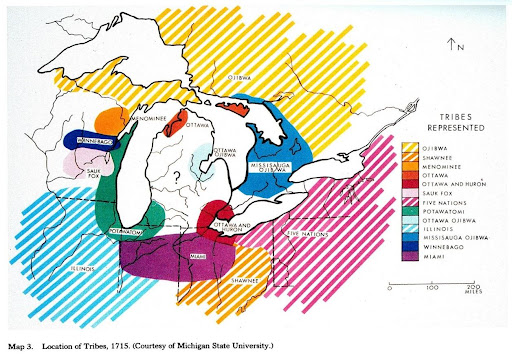
The striped yellow is Ojibwe, green along the bottom and west of Lake Michigan is the Potawatami, and the three red spots are the Odawa or Ottawa. The light pink beside the green is the Sac Faux tribe to whom William Jones belonged.
So it's interesting to me that today's story, The Ottawa Woman, told by John Pinesi who is Ojibwe-Anishinaabe, is about Udāwā’kwe, whose tribe was responsible for trade relationships.
Once, in the long ago, Udāwā’kwe lived alone. She could make things, and make things she did. She made mats and bags, she spun twine. And because she was busy making things that people needed, she wasn't sad that she was alone.
One day she felt something within herself, a baby, and after she gave birth to a Ruffed Grouse all the various creatures of the air were born. As fast as she gave birth to these beings, they flew off and left her alone, but the Ruffed Grouse said she would never leave, she would always be nearby no matter where their mother was.
Another time Udāwā’kwe felt she was with child and this time she gave birth to all the game-folk. Again, she was forsaken as fast as she delivered them but the Hare did not forsake her. The Hare said he would never leave their mother. There was a rock nearby that looked like a hare and the people noticed it, calling it A Hare that is Always Seated.
A third time she felt herself with child, and this time she gave birth to fish, as many fish as there are in the world and you guessed it, they all swam off except for one. The Whitefish said they would never leave their mother, vowing that in every place that a lake may be, there would be whitefish.
Then Udāwā’kwe, because that's the name that our grandmother was called, went back to making all sorts of things, and that's as far as the story goes.
The connections between Ottawa Woman and other stories about how these various beings came to exist are hard to miss, particularly since in this story they happen in the same order as the earlier stories. Jones, perhaps at the behest of Pinesi, made a point of including a footnote telling us that the Hare in this story is not Nanaboozho who ended his brothers (releasing birds and then four leggeds) and then killed the Giant Toad Woman (releasing fish, frogs, and toads) signalling something different about this story. Ottawa Woman is not just another version of the same thing, it's part of a much larger story. Nanaboozho's actions took place in spirit world, perhaps this is a story about how they came to exist here.

Nanaboozho's violence unleashed transformations in spirit world that became material in this world through Udāwā’kwe. She is how these beings entered our world from that other one, spirits made material through the process of birth. For me that part clicks together fairly easily, but you don't need to believe in Anishinaabe cosmology to accept it as a story with things to teach us about how to live well in this world. What niggles at me, what I am curious about, is why an Odawa woman is the portal between worlds, the griot if you will.
In west African traditions, a griot is a storyteller, a poet, or a musician with the power to pierce the veil between worlds. Sammie, the blues player that the movie Sinners revolves around, calls in the past and present. That is his gift. Others have other gifts, other beings that are drawn through the veil. The film says that for the Choctaw, this gift is held by firekeepers which makes sense. A firekeeper would know songs and stories. Fire is a portal, accepting our offerings.
Not that I have any objection to it being an Odawa woman, but Pinesi was Ojibwe, so why not make it about his own tribe? For that matter, why specify the tribe at all? Most of the stories don't, they just talk about people, but this story identifies her so being Odawa matters to the story itself. That one baked my noodle for a minute until I looked up Odawa which lead me to information about the Council of the Three Fires and when I typed the words "whose tribe was responsible to maintain trade relationships" the penny dropped.
Because that explains it right there.
The Odawa were responsible for trade relationships that the Anishinaabe had. Not just with the Ojibwe and Potawatami but with everybody. Everyone that the waters of this continent could get you to which, with a few portages here and there, is basically the entire hemisphere. It makes sense that an Odawa woman would be the portal for all these spirit beings. The responsibilities of the Ojibwe and Potawatami are more insular, welcoming others in but not extending out and often having protocols that act as protective barriers. Having the tribal group with an outward facing role, with the responsibility for creating and maintaining broad transnational relationships as the portal tells us something very important about Anishinaabe priorities regarding trade, as conveyed in our stories if not always our lives.
Trade relationships among societies who place a high value on non interference are going to look a lot different than they do in our contemporary world of coercive power. Negotiations are based in mutual flourishing rather than human need, the patterns that develop means the end result benefits everyone for real, not like a mafia protection racket or promises to allow basic necessities if you agree to a regime change. And of course by everyone, I mean everyone. Not just humans. Our stories contain treaties and agreements made with the other than human world as well, trade relationships of a kind that governed hunting and harvesting patterns. Relationships that had to be maintained through goodwill and reciprocity.
In the movie Aliens, Burke, a company man, tried to infect Ripley and the child Newt with xenomorphs to bring them back to earth for the Weyland-Yutani Corporation to study and exploit. He's caught, of course, and Ripley muses that she doesn't know which species is worse, but "you don't see them (the aliens) fucking each other over for a goddam percentage."
By tying trade relationships to the arrival of all animals, this story offers us a way to conceptualize the world and our relationships to human and other than human kin much different from the free market framing that the western world relies on. We live in a world where people will fuck each other over for a percentage, entire civilizations threatened with annihilation for the sake of access to resources and a bottom line that benefits fewer and fewer people. We live in a world of heirarchies and individual rights that rarely take the rights of others into consideration.
These stories return us to something different, something more human .. a global community of beings, some human, most not, all of whom are related, connected. Not just by virtue of being on this planet and sharing the resources but through Udāwā’kwe who was the conduit by which these spirit beings arrived here. The Ruffed Grouse, Hare, and Whitefish all identified her as their mother, Pinesi calls her our grandmother. We don't have to become kin, we are kin. But what kind of kin are we being?
Ted Talk by Keolu Fox, a Kānaka Maoli geneticist. When he says that the land is his ancestor, that is a scientific statement. Again, not woo woo or mysticalology. It's science. The land acts on our genome just as our ancestors did. We are related to the land and other beings. It's in our DNA. Kerry and I talked with Fox on our podcast Medicine for the Resistance.
Let's think about who Udāwā’kwe was. A woman living alone who made things. We don't know anything else about her. Nothing about her character or why she was chosen. We can speculate, but that would be all we're doing. The story doesn't seem to care much about how deserving she is to be this portal from one world to another. On the other hand, we are obsessed with this idea. Obsessed with the notion of people getting what they deserve or being worthy in some way. Many stories have to do with people being chosen for one thing or another because they were worthy and that has filtered into our consciousness and impacts everything from personal relationships to government policy.
Udāwā’kwe made things. I wonder if people stopped by to learn these skills from her, if children sat with her to spin and weave, if they walked with her while she harvested materials and listened to her tell stories about the various plants and animals. I wonder if caregivers stopped by to visit while they picked things up and what they traded her for these items, if hunters who relied on her twine and her mats brought her food. I wonder about the animals who promised not to leave her, and if the others sent back stories about their travels the way my children send me photos of the places they go. I wonder if that's why she wasn't sad about being alone, because she wasn't alone.
If Udāwā’kwe is a griot, a powerful storyteller with the ability to pierce the veil between worlds, then we might expect her to be Ojibwe (keepers of the faith) or Pottawatami (keepers of the fire) since faithkeepers and firekeepers hold stories and music with the power to open worlds but she isn't. And maybe I'm overthinking this, but when people travel long distances for trade they don't just bring back material items. They bring back stories and songs, stories and songs with their own power to pierce and open and call forth.
I don't know if she was a storyteller. This story is very brief and as I said, we don't know very much about her. But we know that she pierced the veil between worlds and became a conduit for fish, fowl, and four legged spirits to enter and transform our world. We know that she came from a tribe responsible for trade, people who made journeys and agreements. People who sat around fires with strangers and old friends beneath the night sky and whose stories she may have woven in with her own. That scene in Sinners, the clip I shared with you, shows Asian ancestors dancing when Chinese shopkeepers Bo and Grace stepped onto the dance floor. A storyteller with this power will call in everyone's past and future to enter and transform this world. Whatever Udāwā’kwe was, she was powerful and she is our grandmother just as she is the mother of those animals. The land, and all it contains, is my ancestor as surely as my human ancestors are. According to Kanaka Maoli geneticist Keolu Fox, that is a scientific statement.
I don't want us to get distressed over the birds, game animals, and fish "forsaking" Udāwā’kwe, because Anishinaabe aki would be an awfully crowded place if they had all stayed. The geography of the Anishinaabeg is not suitable for all animals, those who are best suited to significantly different climates would need to hightail it out of there and get to the place where they belong. Those who stayed, the whitefish, ruffed grouse, and hares, are all at home in the lands of the Anishinaabeg ... staying close to their mother as promised. And THAT makes me wonder about the environmental changes due to climate change and industrial violence and the disappearance of ruffed grouse, hares, and whitefish from the places that kept them close to Udāwā’kwe, is that another kind of world ending?
That's something to wonder about on your own.
baamaapii
Chanda Prescod-Weinstein, in her book The Edge of Space-Time: Particles, Poetry, and the Cosmic Dream Boogie, brings up the role of griots, west African story tellers who can "pierce the veil" between worlds as the intro to the movie Sinners describes them. Ojibwe storytellers like Pinesi, Syrette, and the others who shared stories with William Jones also pierce the veil between worlds, and Prescod-Weinstein herself does this by telling the story of the cosmos, of an entire universe coming into existence from the perspective of physics. It's a wonderful book, full of storytelling, surrealism, and physics.
Anishinaabe Ways of Knowing and Being by Lawrence Gross also takes up the ideas of quantum physics along with so much more about how Anishinaabe language and cosmology shapes a very particular way of being in the world.
Talking about alternate worlds, horror brings us stories about relationships gone wrong, about what happens when we don't take the other than human world, or the existence of other worlds, seriously. I'll Make a Spectacle of You by Beatrice Winifred Iker is a Southern Gothic horror set in a Black college protected by The Beast and it's keepers. Moving from a haunted campus to a haunted house, Johnny Compton's The Spite House is the story of a single father and his children trying to understand their own history by taking a job at the most haunted house in Texas. The Reformatory by Tananarive Due is set in a reform school during Jim Crow in Florida, the haints at the Dozier School for Boys find a child they can communicate with, a Black 12 year old boy sent up for a crime that no white child would have been committed for. Indigenous horror is showcased in the short story anthology Never Whistle at Night and the sequel, Back for Blood that releases in August 2026.
Order your copy of Bad Indians Book Club today in the US through Bookshop.org, and in Canada: Indigenous owned GoodMinds, as well as indie books which will show you which local bookstore has it in stock. Get it wherever you get your books.
Podcasts and Interviews!
Science and Nonduality network Sounds of Sand podcast
The Radical Sacred
Missing Witches Part 1 and Part 2
Turning Pages
A Matter of Faith: A Presby Podcast
CBC's The Next Chapter
New York Society Library
Shawn Breathes Books
Book reviews!
In Windspeaker News
Featured by Poets and Writers as one of "best books for writers"
Featured by the Library Journal's reading list for Native American history month
Featured by Goodreads for Native American Heritage Month
Featured by Powell's Books for Native American Heritage Month
The Miramichi Reacher
I've Read This
Pickle Me This
Foreword
Reading Our Shelves
Red Pop News
On Our Radar: 49th Shelf
Ms Magazine's top 25
Summer Must Reads Toronto Star
CBC Books 45 Canadian nonfiction books to read this fall
One of the 100 Best Books of 2025 from Hill Times
My list of "must read books" for CBC on TRC Day, Sep 30 2025
An excerpt published by Baptist News Online.
Do you want me to zoom into your local bookstore or bookclub? Talk with you on your podcast? I can do that. patty.krawec@gmail.com For larger professional settings you can email Rob Firing at rob@transatlanticagency.com
Want to add Bad Indians Book Club merch to your life? Get your Live Laugh Lurk on at Johnnie Jae's shop where she sells tshirts, stickers, tote bags and so much more. And that cover art by J NiCole Hatfield is stunning isn't it? She sells prints, cards, and more on her website.

And don't forget to join up with the Nii'kinaaganaa Foundation. Every month we collect funds from people living on Indigenous land and redistribute them to Indigenous people and organzers. You can find out more information on the website which is now powered by ghost, which means that you can become a subscriber there just like you are here! You can sign up on the website to be a monthly donor or make a one-time donation right here.