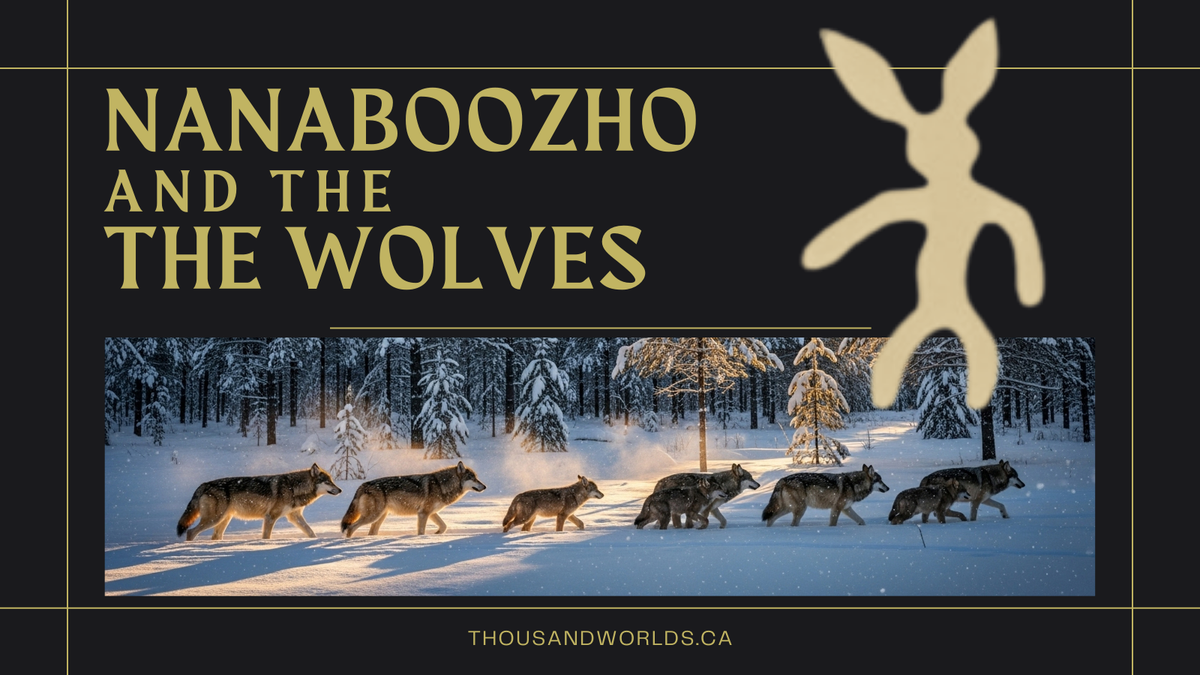
Nanaboozho and the wolves
I often quip that I am the most indoor Indian you'll ever meet. And that's true, in the winter I tend to make my tobacco offerings in our fireplace letting the smoke carry my gratitude and intentions into the world because I don't want to go outside in the cold dark of a winter morning. But for the past three weeks I've been smudging and praying outside, finding myself enjoying the stillness of these snowy winter mornings that are dark without even the barest hint of sunrise yet. At 6:30am in January the glow to the east of my house is Grand Island, NY, nothing to be excited about. I scatter my tobacco carefully around cedar trees before shoveling the walkway and a path through my garden to a very specific cedar tree beloved of our new friend. Being outside in the winter morning is not my first choice, but here I am. And this is why.
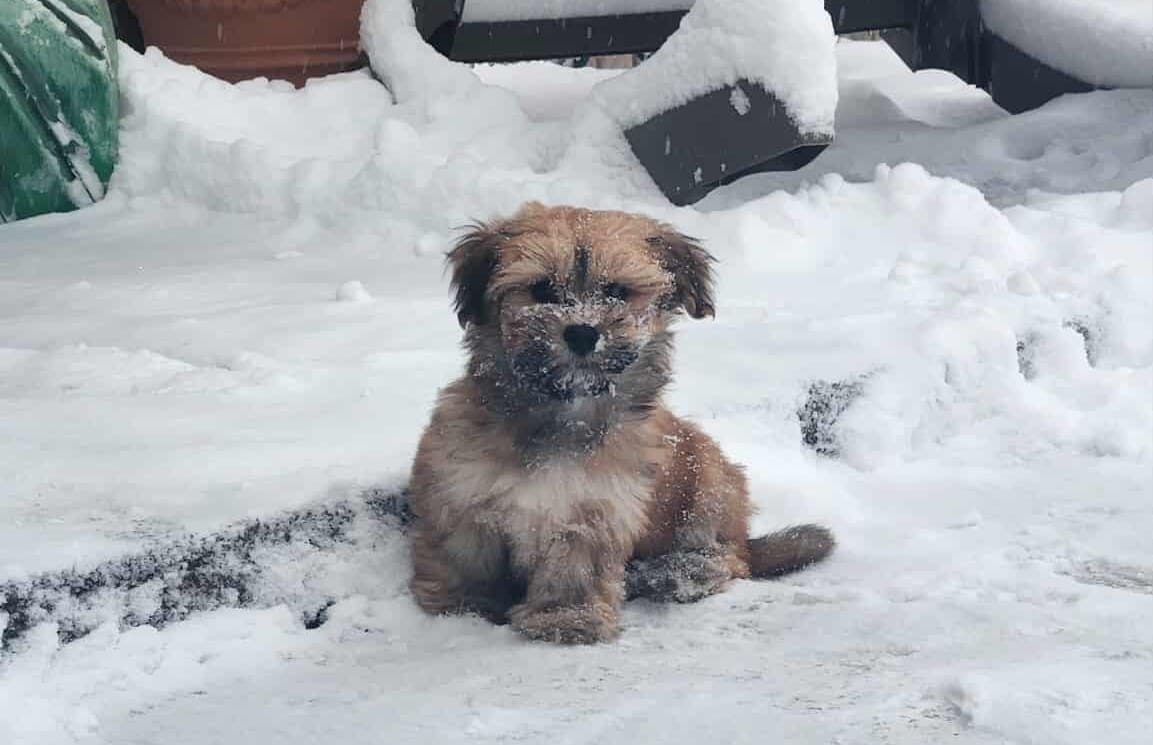
It's been over a year since our other pups walked on to be with Steve Irwin (the only afterlife I accept for animals). We travelled and camped without pups for the first time in 30 years which was its own kind of nice. But one day I knew that it was time and now we've got a very small pup who is a lot of fun but also a little judgemental.
This is a story about how Nanaboozho got his own pup. Just not as small or young as Gordon.
We've visited with this story before, Nanaboozho and the Wolves. It's a prelude to the flood and the earthdivers, stories we have read and wondered about before but are coming back to in the midst of a world heaving with change. We are visiting with them again to look for relations and movement. Our stories are, as Margaret Noodin writes, memory in motion. They are a gift from stones who, she says, in the long ago taught humans to take their minds beyond the tangible to where stories waited for discovery, taught them to bring those stories to their communities and learn to work with them, care for them, and respect their life. Interestingly, in West Africa there is a story of Ananzi who brought stories to the people from Nyame, a being whose court was also beyond this world.
So glad you're all here reading! You can subscribe for free or paid. I also have to show some gratitude for Maya Chacaby whose teachings and storytelling shape so much of how I understand these stories and my own relationship with them. And thankyou to Matthew Behrens for his own inspiration in my reflections.
Stories are functional and entertaining, mundane and filled with mysteries to be investigated and wondered about. They may be riddles to be solved or carry important information about governance and how to live well, often both. We also need to set aside ideas of good and bad, think more about creation and destruction while understanding that neither of these are inherently good or bad either. Things tend to go sideways when we impose our wishes, when our actions interfere with the lives of others. If you read the original text of these stories you'll notice that characters often announce what they are about to do. This stating of intentions is a work around. It tells the universe what you want to do or make happen, and then people/spirit can join you in that or not.
This practice is why our wars were different from those that came from Europe, by the way. A war chief would state his intentions and people would either sign up or stay home. No coercion. Which meant that if the people didn't think his intentions were useful in achieving bimaadiziwin, the war didn't happen. If they didn't like what a leader was doing, they were free to, as my oldest often says, wander off and find somebody else to listen to.
James Vukelich Kaageggabaw teaches about Mino-bimaadiziwin
Stories, particularly sacred stories or aadizokaanag, are not meant to be read once and shelved like a paperback novel you got at a yardsale. They are meant to be visited again and again, preferably with tea and bannock and a pinch of tobacco left outside so the memegwesi and other spirits can smoke their pipes and continue their own work of caring for us and the stories we pick up. I am not the person I was last year when I unwrapped them for the first time, and every time the story is told, the audience is new. So the story is also new.
Today's story in the William Jones archive is told three times. The first version, the one that we are wondering about, was told to Jones by Wasagunackank who was from Pelican lake near the Fort Bois reservation in what is now Minnesota. The second version also comes from Fort Bois, and was told by Midasugaj. The third version came from John Penesi from Fort William, whose wife Marie Syrette also shared stories with Jones. We're going to focus on Wasagunackank's story. You'll recall, perhaps, that Nanaboozho had confronted Nokomis about what happened to his mother, and upon learning that his brothers' squabbling had resulted in her death went Inigo Montoya on them. One brother, Nanapataam, is the sun so a little out of Nanaboozho's reach. Jibayaboos, a chickadee, was killed first, became the ruler of spirit world, and his death released all the birds and flying creatures into the world. Next to die is Hewer-of-Shins who was a deer, and he becomes the father of all four legged beings who are released by his death.
This is why Nanaboozho refers to the wolves as his nephews, they come from his brother Hewer-of-Shins.
So Nanaboozho is off traveling about as he is prone to do and he sees a pack of wolves on their way to a cache left by the younger wolves. They lift one side of their lip in what's either a half smile or a grimace and keep their distance when they speak to him, so he yells "Hallooooo! Why do you always do this? Don't you know we are kin?" Their collective sigh landed with such a thump it slowed them down long enough for Nanaboozho catch up to them. The first night they made camp and Nanaboozho was cold, having, as usual, packed inadequately. Commanded to help their uncle, the younger ones cover him with their tails. "Sweaty. Smelly. Yuck." Nanaboozho casts off the tail and is soon chattering in his sleep which no doubt woke the old wolf who probably doesn't sleep any better than I do now that I'm old. Once again commanded, the younger ones cover their uncle.
On this trip the wolves light a campfire jumping over the kindling, travel great distances, and finally arrive at the place where the cache is hidden. Nanaboozho doesn't follow instructions but they take care of him anyway. He makes some more disparaging remarks because he cannot see what is actually being offered or shown to him and the pack continues to take care of him. Then he gets a bone stuck in his eye (his own fault) and the wolves are able to revive him with water. Nanaboozho decides to test this water cure by striking the old wolf with a bone, killing him, and then calls the younger wolves to revive him with water which they do.

This appears to be the last straw for the old wolf who tells them that Nanaboozho had hit him with the bone and they were not going to feed him for a while. When the time came for them to part ways, the old wolf gives Nanaboozho one of his sons who would keep Nanaboozho supplied with food throughout the winter.
This is a very condensed version of the story, but it's got the parts that I'm interested in today in terms of relationships and being part of a community. These are Nanaboozho's kin, his nephews on account of him killing his brother Hewer-of-Shins. Not sure if they know that's how they came into existence, but he does claim relationship with them through his brother so maybe that's why they keep their distance from him. Or maybe they've talked to the geese and other beings who roll their eyes when Nanaboozho rolls up. That is a pretty common theme I've noticed, animals keeping their distance from Nanaboozho unless he is in deep trouble. And they often lament that he doesn't listen or do what he is asked to do, which is completely true.
Gordon vs the brush he never met before
Remember Gordon? I'm often reminding myself how much of everything that happens to him is completely new. He has no context for praise or correction until patterns develop: he can chew on this but not that, pee here but not there. It must seem very mysterious until things start to click. So it doesn't do me any good to get mad at him for not knowing things that nobody has taught him yet and if you have ever had a puppy (or a toddler) you know how many times they need the same lesson over and over, and how frequently they test those lessons. They aren't just testing for boundaries, they are testing to see what and how things work.
Similarly, it helps to remember that Nanaboozho is the only being of his kind, and was raised by his grandmother to be a changemaker in a world that he has very little context for. I'm not sure if you are an only child, or if you know any, but being the only child AND being told that you are raised for a singular purpose could combine to make one a little much. He is learning how the world works, that his actions have consequences, and that those consequences are often borne by others. This is not to excuse his actions, but to help us understand them. Provides us with some context.
So what are the relationships in this story? There's wolves, with their own internal relationships, and Nanaboozho who is their uncle. The wolves seem to have most of the power here. Despite being a manitou, without their assistance Nanaboozho would have been cold and hungry. Even the greatest harm that he inflicts, killing the older wolf, is remedied with a water cure that the wolves know. So he has power, but it is limited by his lack of knowledge and experience. Which is good I suppose. A powerful being should be limited until it has a little more life experience. Other beings that he kills are transformed, the wolf is revived. Maybe that's because the wolves are not manitou, so if they die they die. Remember last week's story about Blue Garter and our side-quest into the Magic Paint? When there is the potential for wrongdoing, there is something available to act as a balance.
Last time I looked at different versions of this story, this time I'm curious about what else is said about the various elements of the story. We'll get into what Wasagunackank says about wolves next time, but today I was intrigued about the stories in which Nanaboozo tries to get food, many of which we've visited with before. Wasagunackank tells us stories about Nanaboozho trying his hand at sweetberries and sturgeon, artichokes, cranberries, dancing geese, and caribou. None of these stories go well, he is persistently impulsive, doesn't follow directions, bumps around, loses his cache to a group of wolves, loses another cache to some people who may or may not be Lakota, and much like my puppy he gets startled by his own farts. He is not good at hunting or gathering is what I think Wasagunackank is trying to tell us, among many other things.
My friend and teacher, Maya Chacaby, told a story on Facebook the other day about hunting moose in the post apocalypse. It's a great reflection because like everything she teaches, responsibility and relationship are at the core of it. It is not about ego and posturing over your kill, like too many political leaders (on the right and left) as well as their acolytes, it is about caretaking and nourishing your community and then doing it again. Unlike us, this wolf pack did not forgive Nanaboozho's destructiveness because they liked his platform (and before your brain goes exclusively to MAGAts we do this on the left too. Perpetual victim Yves Engler comes to mind). The wolves didn't cancel Nanaboozho, and I am not advocating canceling anybody, but they made the always valid choice to put him to the side for a bit and then part ways, while also remembering their own family obligations and making sure he had somebody to take care of him. They protected the pack and they protected their uncle.
Because here's the thing, as Maya points out, not everybody is a moose hunter. Clearly Nanaboozho is not and his nephews recognized that even if he didn't. He relies on the moose hunters and the wolf pack took care of Nanaboozho because he was their uncle, not because he earned his place in their community or had the right political outlook. The trouble is that there's a difference between relying on the moose hunters out of humility, and relying on them because you think you are entitled to it. There is a difference between being oppressed and kicking over a hornet's nest and then complaining about being stung. Nanaboozho forgets this sometimes. He forgets who he is. So do we.
cool video about caribou (aka reindeer), including footage of a caribou cyclone
I am not a moose hunter. I am caribou. And caribou live in herds, which makes me a little bit sad because I like people about as much as I like being outside. But apparently we live in a society so it's important to find my people. And just to cycle back to Gordon for a minute, being in relationship changes you whether that relationship is with a puppy or people. It changes how (and at what time) you move through the world, what you notice and when. If it is true that we don't care about things until they impact us, then thinking about all the ways that we are connected to the world around us through our possessions, actions, and relations matters because I might not know anyone who works for Amazon, but I am connected to them through parcels and delivery drivers which means their working conditions should matter to me.
Caribou do a couple of things that are pretty cool. If there are predators nearby the herd will circle and circle, a caribou cyclone with animals moving in and out to keep the freshest caribou on the outside where they run the greater distances (that's just science), the tired and the most vulnerable closer to the centre. There is no Great Caribou who leads the herd, just a herd acting together, moving in and out of forward facing positions as they are needed or able. I love that. I want the groups I am part of to be like that.
Another thing they do is dig and dig for lichen, their big hooves pawing through the snow to bring up nutrients that they share with the community in an entirely different way from a moose hunter. Like the moose, caribou are consumed.
I am consumed. My writing and my thinking. Books and blogposts, social media rants and speaking engagements. All of it consumed by others. So I have to ask myself. What am I consuming, what am I digging up with my big hooves through layers of snow. What am I consuming that finds its way into my work one way or another? Am I nourishing my community? Or just grandstanding. Little of this and little of that if I'm honest.
Lots to think about in this story, lots of questions about how the wolves lived with Nanaboozho. Lots of context in the other stories about Nanaboozho trying, and failing, to find food. We all nourish our communities, one way or another.
Baamaapii
In October 2023 I heard Antony Loewenstein on Movement Memos, talking about how Israel's tools of occupation are tested on Palestine and exported globally. It's a fascinating conversation and prompted me to buy his book, The Palestine Laboratory: How Israel Exports the Technology of Occupation Around the World, published in May 2023. It may have seemed like fear-mongering to people, but all you have to do is look at Minnesota right now to see the truth of it. During the George Floyd uprisings Palestinians were tweeting their advice for how to deal with an occupying army, how to respond to tear gas. Their government has been doing much the same with other imperial nations while showing the world what kind of violence it is possible to get away with.
Against Purity: Living Ethically in Compromised Times by Alexis Shotwell. I have recommended this so many times to so many people. We want clean hands very badly, to shop and consume correctly but what if that's the wrong emphasis? I don't mean that we should abandon attempts to live ethically, I mean our emphasis on clean hands. What if we emphasized the relationships that our compromised state invites us into while also trying to live ethically?
I am currently reading Poppy State: A Labyrinth of Plants and a Story of Beginnings by Myriam Gurba because my friend Robyn gave it to me saying she had just finished and needed somebody to talk about it with. It's a book about relationships with history and botany and memory and place. Extraordinary narrative nonfiction that will help you understand a little bit more about Indigenous California and Mexico.
And I can't talk about nourishing our communities without mentioning The Cooking Gene: A Journey Through African American Culinary History in the Old South by Micheal W Twitty or Chími Nu'am: Native California Foodways for the Contemporary Kitchen by Sara Calvosa Olson. Both authors weave storytelling and family history with recipes (only Olson's is a true cookbook, but every chapter of Twitty's work ends with a recipe)
From the Miramichi Reader, which chose Bad Indians Book Club as one of their best nonfiction of 2025: “There is so much to learn here, so many starting points for dialogue, so many opportunities to clear space and grow. Patty Krawec emerges as a voice for the ‘bad Indians,’ all those pushed to the margins but refusing to be defined by them.” — Anne Smith-Nochasak
Order your copy of Bad Indians Book Club today in the US through Bookshop.org, and in Canada: Indigenous owned GoodMinds, as well as indie books which will show you which local bookstore has it in stock. Get it wherever you get your books.
Podcasts and Interviews!
The Radical Sacred
Missing Witches Part 1 and Part 2
Turning Pages
A Matter of Faith: A Presby Podcast
CBC's The Next Chapter
New York Society Library
Shawn Breathes Books
Book reviews!
In Windspeaker News
Featured by Poets and Writers as one of "best books for writers"
Featured by the Library Journal's reading list for Native American history month
Featured by Goodreads for Native American Heritage Month
Featured by Powell's Books for Native American Heritage Month
The Miramichi Reacher
I've Read This
Pickle Me This
Foreword
Reading Our Shelves
Red Pop News
On Our Radar: 49th Shelf
Ms Magazine's top 25
Summer Must Reads Toronto Star
CBC Books 45 Canadian nonfiction books to read this fall
One of the 100 Best Books of 2025 from Hill Times
My list of "must read books" for CBC on TRC Day, Sep 30 2025
An excerpt published by Baptist News Online.
Do you want me to zoom into your local bookstore or bookclub? Talk with you on your podcast? I can do that. patty.krawec@gmail.com For larger professional settings you can email Rob Firing at rob@transatlanticagency.com
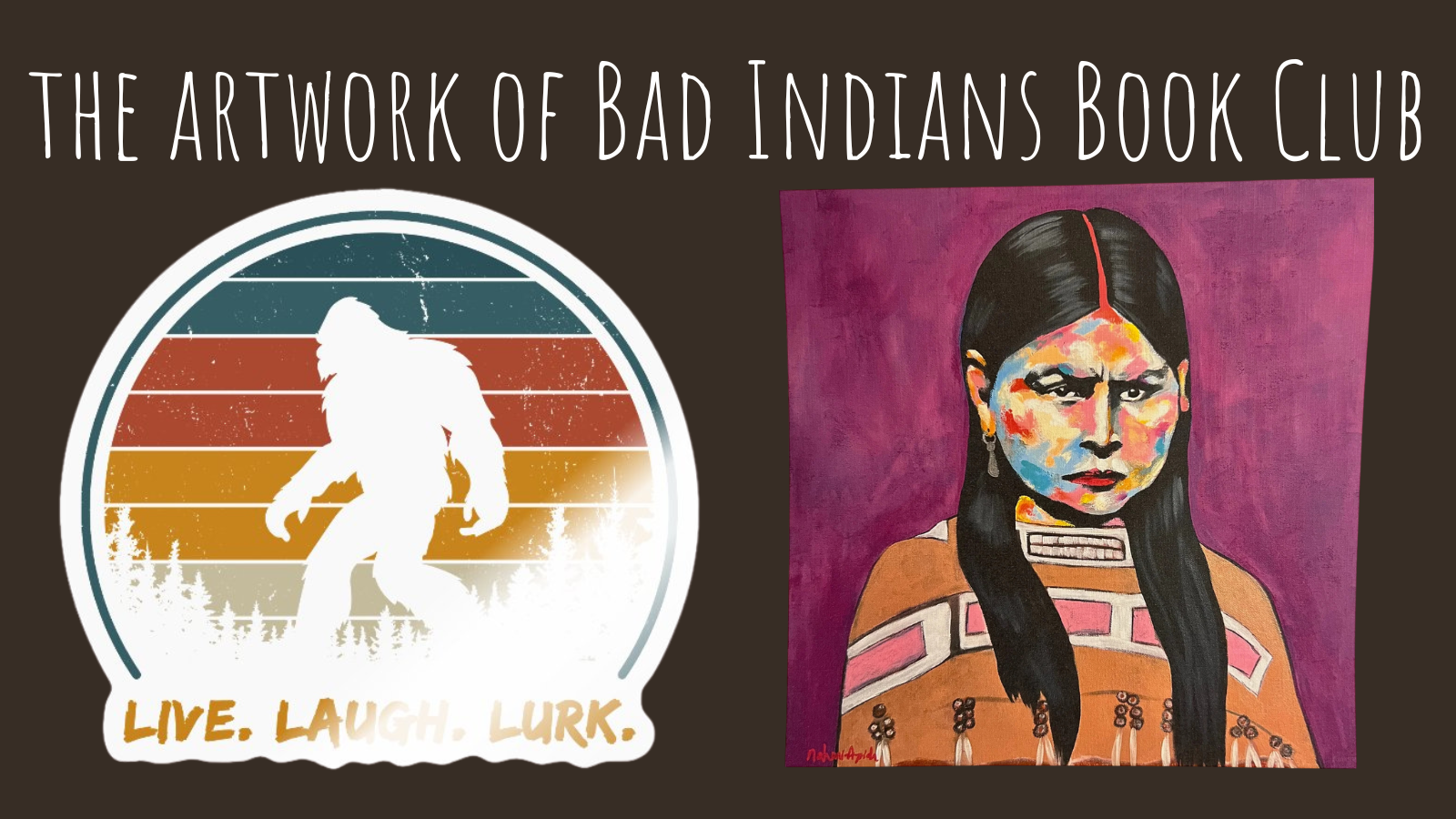
Want to add Bad Indians Book Club merch to your life? Get your Live Laugh Lurk on at Johnnie Jae's shop where she sells tshirts, stickers, tote bags and so much more. And that cover art by J NiCole Hatfield is stunning isn't it? She sells prints, cards, and more on her website.

And don't forget to join up with the Nii'kinaaganaa Foundation. Every month we collect funds from people living on Indigenous land and redistribute them to Indigenous people and organzers. You can find out more information on the website which is now powered by ghost, which means that you can become a subscriber there just like you are here! You can sign up on the website to be a monthly donor or make a one-time donation right here.