The trouble with stories
“It matters what matters we use to think other matters with; it matters what stories we tell to tell other stories with; it matters what knots knot knots, what thoughts think thoughts, what descriptions describe descriptions, what ties tie ties. It matters what stories make worlds, what worlds make stories.”
― Donna J. Haraway, Staying with the Trouble: Making Kin in the Chthulucene
A few weeks ago I was in Toronto and spoke at a gathering for Indigenous and settler Anglican clergy and laypeople. Scanning the tables for a place to have my coffee the following morning, I spied a couple of elders at a table with empty chairs. I then spied the surname Wesley on the man's name tag. Within a few minutes we were sharing stories and forming connections, threads that tied me to people as well as the places where our families, clans, and tribe emerged from the mashkiig north of what is currently Lake Superior
I've been puzzling a way to write about Thomas King without just repeating things that have already been said and travelling in directions that are well worn but not always helpful. It's not as big a shock as Buffy, for one thing Buffy straight up lied and got busted. She combined her own desire for a different history with a story she heard about a Cree family who had lost a daughter and a grandbaby that would be her age. Exploiting their grief, she fabricated a relationship with the family and their community. King didn't really lie to us, not in quite the same way. He was given a fiction by his mother and instead of investigating it, he dedicated his life to preserving it.
King told us who he was.
The claim was always pretty flimsy. His mother told him that despite the documentation, his biological grandfather was a Hunt, not a King, and that Elvin Hunt was Cherokee. This scholar, who surely expected better critical thinking from his students, protected this story and over the years he covered the balloon his mother gave him with bits of red tissue paper, creating a papier mâché life that we admired and sympathized with.
We sympathized because us too. Far too many of us too have nothing but fragments to paste together. For decades government representatives from band managers to child welfare workers rewrote family histories in a flurry of paperwork and bureaucratic genocide. Legislation about Blackness (one drop rules) and queer life caused our communities to seek a form of safety by rejecting their own people. Today, disconnected from their own histories, white people confabulate a past by spitting for companies like 23 and Me while people like my father do DNA tests to challenge these fraudulent records and prove that their siblings and cousins are their siblings and cousins. Not just because it is important to know that the fragements have substance, that the glue will hold, but because stories are the glue and the resulting family connections form a honeycomb of stability beneath the tissue covered surface.
"the fraud, the Cherokee or Metis 'Indian' [] is claimed by non-Indigenous, predominantly white, individuals and groups who benefit from and within the social and material conditions. It allows them to pretend an identity and history that transcends accountability to the ongoing conditions of genocide and dispossession. It serves to discredit and disparage Indigeneity even as it claims Indigeneity as its own.'"
Joanne Barker, Red Scare: The State's Indigenous Terrorist, cited by Jodi A. Byrd in Indigenomicon. Emphasis my own.
For somebody who loves stories as much as King does, in retrospect it seems odd that he did not want to buttress his papier mâché shell with chicken wire connections and the crumpled newspaper of family life.
King did find a cousin dangling from the Hunt branch of the family tree, red tissue paper in hand. And that's where this skilled researcher stops. Papier mâché made on a balloon is fragile after all and needs to be guarded from anything pushing too hard against it. He sought no confirmation of this family lore from the extremely well-documented tribe that was right there and despite the omnipresent marketing of DNA tests, made no attempt to challenge the records by proving his relationship to the Hunt family. Of course, eventually we all learned that, related to Elvin Hunt or not, Hunt was not Cherokee and neither is Thomas King.
The problem with King is how easily we all accepted him as a free-floating Indian-at-Large, to use his own words.
Every urban community has such people who are either constructing or protecting a story of Indigeneity. They join our community spaces with flimsy claims that nobody, including themselves, examines. They are Indians at Large, some of whom go on to one or another public facing position, but most of whom do not. Their reluctance to examine their own story most likely stems from not wanting to risk a story that explains why they are, or wish they were, different. Our reluctance often comes from a desire to be welcoming and generous as well as the knowledge that colonialism has made a real mess out of everything. "Who claims you?" is a fraught question for queer and Afro-Indigenous people, the communities they claim may have refused their ancestors for racist and/or queer and trans-phobic reasons.
Eventually, like those contestants on American Idol whose friends have always lied and told them they are great singers, some of these people with flimsy stories walk onto the stage and have their lives shredded by pretendian hunters whose verbal violence is part of the show.
I understand the desire to protect things worth protecting, but we need to be careful about replicating colonial practices while we do that. This is something that cuts broadly across oppressed and colonized communities, something my friend Maya Chacaby researched recently and posted about on Facebook. After surviving what was meant to be unsurvivable we work desperately to preserve what remains. Using what we learned in government-run schools, we decide on the stories by which we will judge other stories, which descriptions validate other descriptions, which stories create an Indigenous world and which Indigenous world is permitted to create stories.
The trouble, as Maya notes, is a reliance on stereotypes and documentation developed by the very people who set out to destroy us. As a result the people we say we are doing this for stay away out of fear they will be scrutinized in ways they cannot address, but perhaps could if we let them in. Ultimately this does the work of the colonizer. They no longer have to disappear us, we disappear ourselves.
It's tricky, and Maya offers us alternatives that largely rely on not weaponizing these things against ourselves and each other, not relying on colonial tools and strategies, and recognizing that there are multiple truths. I believe that one way we get at that multiplicity is by putting multiple stories about ourselves together to see how they inform each other. So that's what I'm going to do next.
Nanaboozho, that central trickster of Anishinaabe traditional stories, was lowered to earth as Original Man, part human and part manitou. He was all alone, a solitary mixed race being walking the earth, naming things. When he lamented to the Creator that everybody else was travelling two by two, Creator gave him a wolf. He walked around the world again with his wolf friend, which is kind of nice because you see things differently when you're with a friend.
~ taken from The Mishomis Book (Eddie Benton-Batai) and Braiding Sweetgrass (Robin Wall Kimmerer).
It seems to me that King, and the Indian at Large persona he claimed with far more credibility than he claimed Cherokee, was kind of like Nanaboozho in this story. An Indian at Large can be almost anything and Cherokee is rather specific. An Indian at Large belongs everywhere and to nobody, unlike the Cherokee who belong to very specific geographies and people. Like Nanaboozho in this creation story, an Indian at Large has no history, no family, and wanders the world creating stories about the things that they see.
Reading any of our stories in isolation leaves us vulnerable to harmful or unhelpful readings. Not just because of the story itself but because of where reading in isolation takes us, Robin Wall Kimmerer isn't alone in describing Nanaboozho as the first immigrant. I don't think I'm splitting hairs, words mean things and the context in Braiding Sweetgrass demonstrates that Kimmerer understands what immigrant means, drawing a straight line from Nanaboozho to a country that is largely immigrant now. Using this language, she describes Nanaboozho and Skywoman as good immigrants like plantain. Others are bad immigrants, like purple loosestrife. In general I do like that framing as it pertains to immigrants. What I don't like is describing Indigenous peoples in general, or Nanaboozho and Skywoman in particular, as immigrants who just got here earlier because that has political consequences. Nor do I like the idea that anybody can, through relationship, become Indigenous.
Because that's what Thomas King did. This Indian without history, an immigrant who fell from the sky, landed in California, and then built a community out of those who were around him around him became Indigenous. Of course, we could argue that by ignoring the Cherokee themselves he did not enter into these other relationships honestly but telling the story of Nanaboozho's origins in isolation from other stories of his origins disconnects Nanaboozho from his history in much the same way.
So let's take the story out of isolation and revisit it with other Anishinaabe storykeepers.
Nokomis falls from the sky after brawling with her sisters. She marries a bear and they have a daughter, Wenona, who disregards her mother's advice and winds up pregnant by the West Wind who continues on his way. The boys squabble over who will be the first born, causing Wenona to die in childbirth. Nanaboozho's brothers achieve independence almost immediately while Nanaboozho, the blood clot who became a rabbit and a boy, is raised by Nokomis.
Nananboozho knows he isn't like the other kids and frequently asks Nokomis about his mother and father, if he has any siblings. He wears her down and eventually she tells him the story of his birth. Subsequent stories chronicle his journeys, along with various side-quests, to find and confront his father and brothers. The wolf who joins him is one of his brothers. An afterlife is created, an evil gambler confronted, a world reconstructed after a flood, and more. All because he insisted on knowing his history, and wanted to confront the people from the stories he was told.
~ from the William Jones archive, Basil Johnston's The Manitous, and Gerald Vizenor's Earthdivers.
These stories about Nanaboozho's origins may seem to contradict each other, but if we put them alongside each other instead of squabbling over which one should be first, we get important context that changes where the story takes us. Nanaboozho has a grandmother with her own history as well as a mother. His father isn't much to write home about and his brothers took off but they all exist. He has a grandfather who, intermittently, helps to raise him. There are other kids and people. Nokomis may have fallen from the moon but the bear was already here, as was the West Wind. Nanaboozho can no longer be understood as an immigrant, he is clearly one of the original people of this place. In this timeline humans don't exist at this part of the story because Nanaboozho hasn't created them yet, so I don't know who those other people are. Ancient memories of archaic people perhaps, Neandrethals, Denisovans and more haunting our stories much like their DNA shows up in our own.
The trouble with stories is that by themselves they're flimsy. Us too may have flimsy stories. May have a mother, or grandmother, who explains our difference with an absentee parent and not much else. But we don't accept the notion that we are alone in the world, dropped from the sky to live without history. We collect and then paste our fragments of red tissue paper on an increasingly stable framework of chicken wire connections and crumpled paper stories pulled from what we learn about our connections to history and family members who left us behind or from whom we were taken. We go looking for those stories, as many stories as we can gather.
Like Nanaboozho, King also pestered his mother about why he was not like the other kids and she gave him a story. The problem with King is that he allowed himself to be defined by that story, and then protected the shell rather than strengthening it. Unlike Nanaboozho, he didn't question the story, didn't go looking for relatives to confront and provide additional information. Didn't put it alongside other stories to see how they fit together or challenged each other. Didn't put his mother's story alongside the history of allotment that shaped contemporary Cherokee and the history of the Dawes Rolls that governs their citizenship.
He stayed in the isolated story of an isolated mixed race being wandering the earth by himself, perhaps with a dog, and making up stories to explain what he saw.
We have all been raised in a world that imagines us as a individuals without history. Individuals at large, wandering the world and collecting stories that we paste on ourselves. My maternal family fled Stalin and then postwar Germany. Like many refugees, they did not talk much about their traumatic history and focused on the life they were building here. It is an isolated and isolating existence that my father and his history offered me a path out of. More, by putting my maternal and paternal stories alongside each other, instead of allowing them to jostle for primacy, a complex narrative of displacement and placement emerges. Common ground between the Ukrainian and the Ojibwe experiences that provide a rich soil for solidarity. A place to root myself in history and stories about that history with relatives and friends. The ruptures in our history are traumatic, but for Indigenous peoples it is often recent enough that scar tissue can still form to pull the edges back together. Not the way it used to be, scar tissue is what it is, but it's something. Others whose disconnection is more distant, or whose histories place them on the wrong side of displacement narratives may need to work harder, work differently, to find a pathway to belonging that does not displace Indigenous people or their own ancestors. Staying with the trouble you have inherited means holding it in your hands and allowing it to inform the kind of solidarity and justice you seek.
Because when you think about it, whether you are creating an Indigenous life out of whole cloth or protecting a flimsy story that explains why you're different, it's not only disrespectful towards your own ancestors, but it cuts us all off from a truly liberatory future. And whatever belonging you do find will be not only be shallow and unrewarding, it will ultimately discredit and disparage Indigeneity even as you claim it as your own.
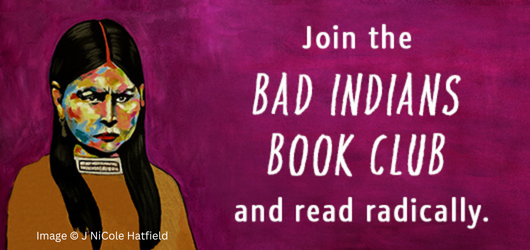
From Red Pop News: Krawec challenges us to read with intention, to notice the silences, and to bring the stories pushed to the margins back into the center. Her work reminds us that stories aren’t just inherited, they’re chosen, shaped, and lingered in until we’re ready to step forward.
Order your copy of Bad Indians Book Club today in the US at Bookshop.org, Amazon, Barnes and Noble, and in Canada: Indigenous owned GoodMinds, as well as Amazon, indie books, and Chapters Indigo. Get it wherever you get your books.
Podcasts and Interviews!
Missing Witches Part 1 and Part 2
Turning Pages
A Matter of Faith: A Presby Podcast
CBC's The Next Chapter
New York Society Library
Shawn Breathes Books
Book reviews!
Featured by Poets and Writers as one of "best books for writers"
Featured by the Library Journal's reading list for Native American history month
Featured by Goodreads for Native American Heritage Month
Featured by Powell's Books for Native American Heritage Month
The Miramichi Reacher
I've Read This
Pickle Me This
Foreword
Reading Our Shelves
Red Pop News
On Our Radar: 49th Shelf
Ms Magazine's top 25
Summer Must Reads Toronto Star
CBC Books 45 Canadian nonfiction books to read this fall
My list of "must read books" for CBC on TRC Day, Sep 30 2025
An excerpt published by Baptist News Online.
Do you want me to zoom into your local bookstore or bookclub? Talk with you on your podcast? I can do that. patty.krawec@gmail.com For larger professional settings you can email Rob Firing at rob@transatlanticagency.com
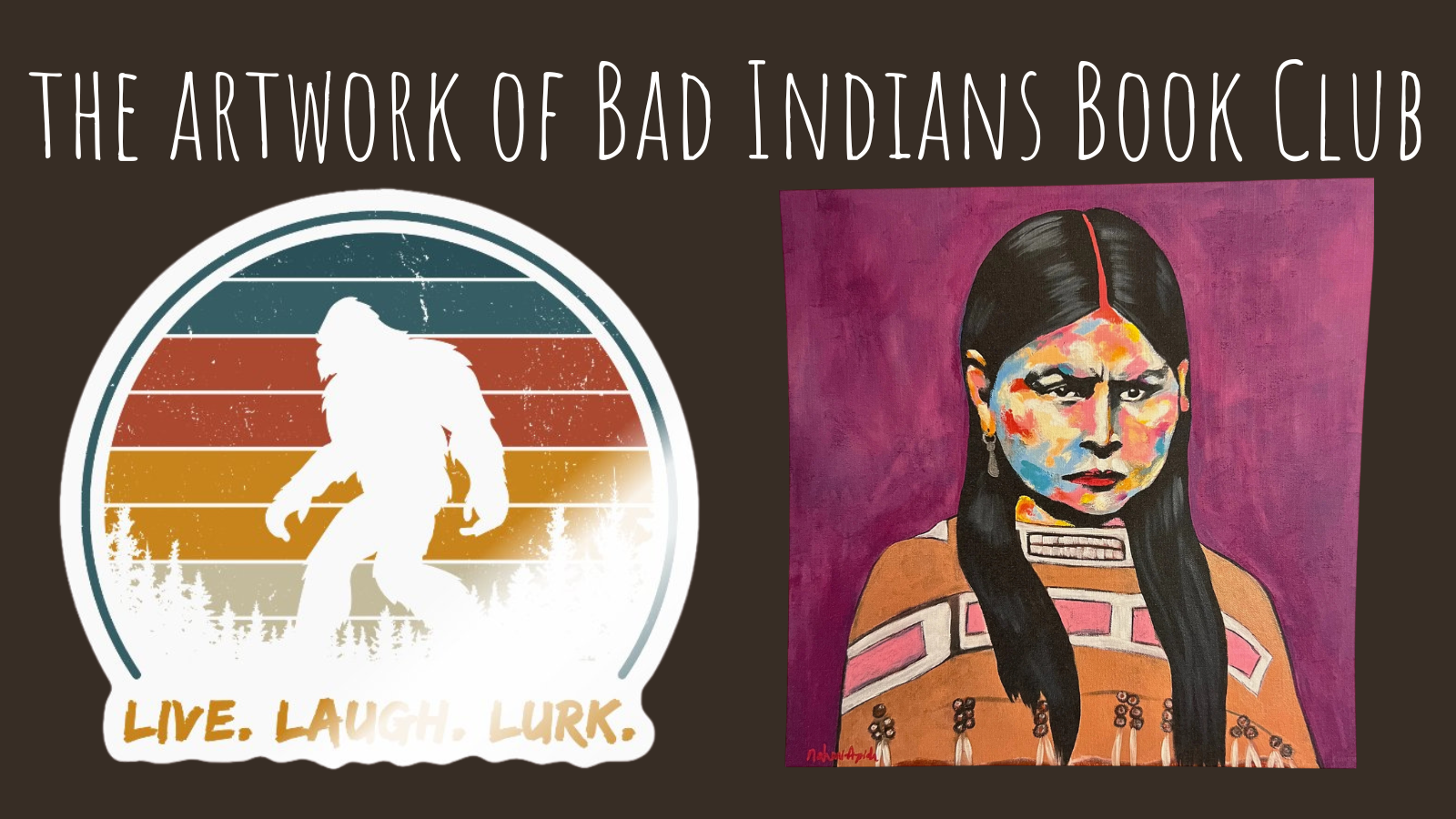
Want to add Bad Indians Book Club merch to your life? Get your Live Laugh Lurk on at Johnnie Jae's shop where she sells tshirts, stickers, tote bags and so much more. And that cover art by J NiCole Hatfield is stunning isn't it? She sells prints, cards, and more on her website.

And don't forget to join up with the Nii'kinaaganaa Foundation. Every month we collect funds from people living on Indigenous land and redistribute them to Indigenous people and organzers. You can find out more information on the website which is now powered by ghost, which means that you can become a subscriber there just like you are here! You can sign up on the website to be a monthly donor or make a one-time donation right here.