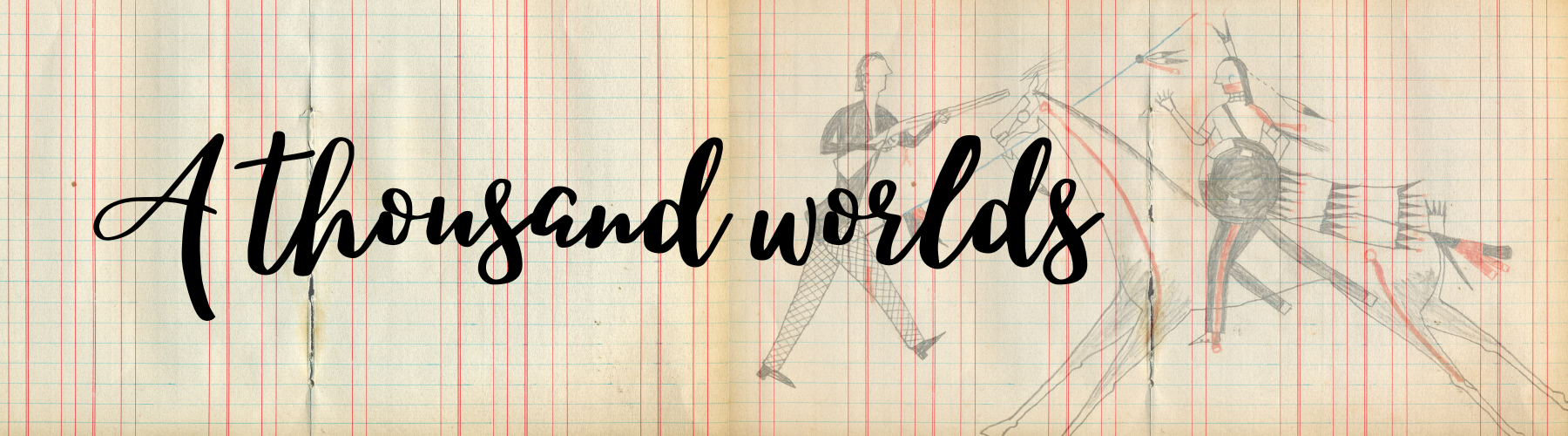
Nanaboozho and Gilgamesh
Bookstores and libraries are wonderful places. You may go in looking for something specific but the books on either side of your quarry, and the displays you have to navigate around, open up new possibilities. A thousand worlds if you will. These places have no respect for your single-minded quest, so you may as well open yourself to side-quests and unexpected treasures. I love visiting bookstores in other cities. Traveling from one bookstore to another introduces me to the stories of the city itself, landscapes and neighbourhoods I may not otherwise notice. Niche bookstores are interesting places where you can find authors and topics you may not normally find yourself browsing.
The fall of 2025 was a chaos of book-launch travel, bouncing from one coast to the other. I've made several brief visits to Vancouver for book related things, so this trip I made it my mission to go to as many bookstores as I could, which suited the chill drizzly days, and is how I found myself in the Indigenous-owned Iron Dog Books.
The booksellers at Iron Dog did not have the book I was looking for, but they did have a chatty staff member who, after a few minutes of conversation, announced that he had something he thought I might be interested in: The First Ghosts: Most Ancient of Legacies by Irving Finkle. I am not at all sure what I had said that prompted this recommendation, and I suspect that it was more his own enthusiasm for it and desire to share it with somebody, but I do like ghosts and horror, so I picked it up along with a couple of others. Finkle is a perfectly named expert on cuneiform writing and I found this book so intriguing that a few weeks later I got his other book The Ark Before Noah: Decoding the Story of the Flood which references a certain tablet that was discovered in the 1800s and transformed a lot of thinking about the flood story.
In that same month I found myself browing a bookstore on Canada's Atlantic coast. Tidewater Books and Browsery is where I happened across There are Rivers in the Sky: A Novel by Elif Shafak who also wrote The Island of Missing Trees that somebody recommended ages ago and has been languishing in my tbr pile ever since. Rivers is a sprawling story about four lives across more than two millennia that somehow come together against the backdrop of the Epic of Gilgamesh and the journey of a single drop of water. One of our protagonists is Arthur who becomes skilled at reading cuneiform in the late 1800's and travels to an archeological dig in Nineveh searching for some lost lines in the epic of Gilgamesh where he discovers that flood tablet Finkel wrote about and becomes smitten with a Yazidi woman. Shafak's book is gorgeous, offering various perspectives on the Levant, a part of the world I don't know a lot about, and the colonial practice of "saving" relics.
What does all this have to do with Nanaboozho?
Gilgamesh was a terrible king, violent and abusive and generally not the kind of person you should look up to. But over the course of the poem he changes, he comes to terms with some things, like mortality and loss, and becomes a better kind of hero. Through the character of Arthur, Shafak wonders about this new/old kind of hero who is much different from the pure and good heroes that the West creates and aspires to, modeled after Jesus-the-perfect-man. He is described by Shafak as a "hero-that-is-no-hero [who] matures only after multiple defeats" and later she writes that "it is only through love and friendship and loss that he becomes more humble and gentle." Sounds familiar?
Nanaboozho is not a perfect anything. He too matures only after multiple defeats, learning through love and friendship and loss to become more humble and gentle. Last time we saw how the wolves, initially cautious, cared for him despite the reputation that surely preceded him as well as his own behaviour towards them because he is their uncle. Other animals and beings have assisted him along the way, often despite their own misgivings. We've talked about him killing brothers and generally crashing about, a rabbit in a spiritual china shop whose chaos has significant consquences. Today we're going to think about two stories and how their combination shifted my understanding of Nanaboozho.
First some gratitude. Grateful as always to Maya Chacaby and her weekly circle of wonder that put these two stories together for me. Grateful also to new subscribers including my new Friend With Benefits Karen. Miigwech!
Today I want to think about two stories, one of which we've visited with before and the other is new. Two boys, both sent on a ceremony, with very different outcomes.
We've talked before about Nanaboozho being sent out to fast and how that went completely sideways leaving the Nanaboozho and his grandmother sitting morosely with nothing left to say. That story is called Nanaboozho is Made to Fast by His Grandmother and Revenges Himself. The other is called The Boy That Was Carried Away by a Bear.
That first title is interesting to me, he revenges himself, which suggests a wrong has been done, or at least perceived.
In the first story Nanaboozho is sent out to fast by his grandmother who says "it is only by such means that you can know how you are to live in the future." He's supposed to head down a path and call back until he is far enough to sleep for the night. She tells him to keep going, keep going, at which point he suspects that she's up to something and he comes back to the house only to find that she's getting busy with his grandfather who is a bear. This may or may not actually be his grandfather, it could also simply refer to the generation, but I suspect that it is his grandfather who, according to other stories told by different storytellers, helped to raise him. All kinds of violence ensues: Nanaboozho lights him on fire to get him out of the home he shares with his grandmother and the following day instead of going hunting he goes to his grandfather's house where, through deceit and trickery, he gets him out of the house and kills him. He then compels his grandmother to eat the bear meat knowing that it is her dead lover.
I'm not going to rehash my original reflections, but there's a couple of things to pay attention to this time around:
1. Nokomis did not take Nanaboozho out to his fasting spot, and had no intention of staying nearby in case he needed help. Fasting is a serious ceremony, and things can go wrong. Maybe this is why Ojibwe people have somebody support the faster now? Maybe not, maybe that's something Nokomis should have done and chose not to, hence the "revenge" in the title.
2. Nanaboozho had to trick his grandfather out of Nokomis' house as well as his own, but is able to compel his grandmother to do something she does not want to do. This is a new and dangerous power. Remember the story about Magic Paint? Nanaboozho does this without needing magic paint, but he can't do it to his grandfather. Maybe it's a power that emerges with the death of the bear? I don't know.
In the second story we have a young child who is "chastised frequently" by his father and is taken away by a bear. The bear does not harm the boy and for a year takes care of him as they steal caches of food (Yogi, is that you?) and evade hunters. During the months of hibernation the bear feeds the boy with a variety of foodstuffs that appear on his own back. After a year the boy is returned to his community with the instruction that if he is ever in need of food, to call on the bear and the bear will feed him. The boy fashioned himself a small war club, and whenever he was hungry he would call out, "grandfather I am hungry, feed me," and a bear would appear. The boy would strike the bear, killing it, and have enough food to get through the winter.
The boy does not "revenge himself" on the father who chastised him frequently, the story noting that when the bear returns the boy his father doesn't do that anymore. He could have, the story tells us that the boy made himself a war club, but he doesn't. The story also notes that the villagers are afraid of him, which is probably a reasonable response to the return of somebody they had likely given up as dead. And perhaps something about the boy changed in that year. Perhaps there was some kind of unsettling quiet self-possession that they didn't know what to make of.
It is also possible, as I open myself up to wonderings about these stories, that the boy too was sent on a fast and the story itself is the vision from that fast. Either way, the boy, knowing that he had a powerful protector in the bear, didn't feel any need to revenge himself on the father who had chastised him and the village that failed to protect him. Ceremony can do that, grounding us through connection to the unseen world by making it visible, tangible and helping us to navigate the failings of those around us.
Nanaboozho does revenge himself, having abandoned the ceremony and not had any vision or teaching that would ground him as he moved into the future. And then there's that thing that Nokomis says of the ceremony Nanaboozho is being sent out to do, a truth around which both of these stories revolve: it is only by such means that you can know how you are to live in the future. Consider this purpose alongside Nokomis's purpose in raising Nanaboozho to "make him an instrument by which a new order of things should come to pass in the world." This ceremony by which he would know how he is to live would lay the groundwork for his work as a change-maker which certainly sets a different context for the stories that make up the trajectory of his life as well as our own.
This combination of stories made me so sad for Nanaboozho because of the contrast that is set up and what may have been possible. Both of these boys were sent, or taken, into a ceremony that would determine how they would live in the future. One stayed with it, the other did not. One developed the stability needed to sustain himself and his community, the other did not. One had already experienced a lifetime of being "chastised" and the other was embarking on a lifetime of of multiple defeats and loss just as Gilgamesh did. I think both of these stories are important, and not because one is right and the other is wrong but because they teach us different things which will be relevant at different times. Binaries are to easy, and life doesn't fit well into them.
What you take away, what you learn about how you are to live in the future and the changes that you will bring into the world depends on how you read the stories, where you see yourself and where you see others. You'll recall that many of these stories in the Jones archive model non interference, they show the danger of imposing one's will or wishes and characters often spoke their intentions and then allowed others to make their own choices. I find this a helpful approach, particularly when wrestling with injustice, because there is a sense in which both of these stories are a response to injustice. The boy who is carried away models that non interference, Nanaboozho imposes his will. We do this too don't we, so sure that we have the answer to the injustice we have seen or experienced, angry when people don't do what we want them to in order to address it. So sure that we can and should revenge ourselves, or take revenge on behalf of others. In either case we inevitably respond to injustice with injustice of our own.
A strong social justice movement doesn't operate that way. It allows for diverse strategies, the leaders who emerge speaking their intentions and then working with those who join them rather than imposing a single acceptable way to respond.
May we all mature through defeat, rather than revenge ourselves, and know the kind of love and friendship that brings us gentleness and humility.
There are Rivers in the Sky: A Novel by Elif Shafak is fascinating. Through these characters she examines our willingness to save relics but not water, to dominate a culture by controlling not only their land but their imagination and their stories. I don't often find myself highlighting lines from the fiction I read, but in this book I did.
Cold War on Five Continents: A Global History of Empire and Espionage by Alfred W McCoy. We generally think about the Cold War as a diplomatic dance between the US and the Soviet Union, but it was so much more than that. Even the name is a misnomer, a cold war suggests a war without conflict and there was a lot of conflict with millions of deaths in those decades, most of which was fomented by the CIA in various attempts to stop the expansion of communist governments, at times installing and then supporting brutal and openly fascist regimes. It is the very definition of the imposition of will with the expected violence that comes from such actions.
Talking about the imposition of will. Movement Memos, which readers of this blog will know is my fave podcast, did an interview with journalist Andrea Pitzer, author of One Long Night: A Global History of Concentration Camps on a recent episode called Living Under a Concentration Camp Regime - and Fighting Back. Pitzer looks at the last 100 years of concentration camps around the world, including the network currently being built in the US. The reason I love Movement Memos is that it never leaves us in distress over what is going wrong, the people being interviewed relay strategies for response. The previous week's episode, Minneapolis Community Defense Is “Riding on the Learning Edge of a Whirlwind” is a whole episode about response and community building in occupied Minneapolis.
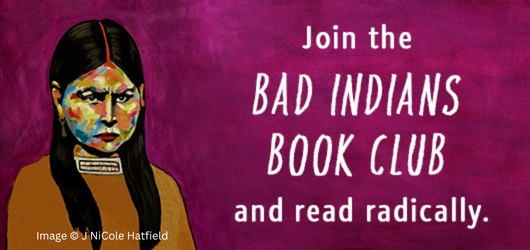
Order your copy of Bad Indians Book Club today in the US through Bookshop.org, and in Canada: Indigenous owned GoodMinds, as well as indie books which will show you which local bookstore has it in stock. Get it wherever you get your books.
Podcasts and Interviews!
The Radical Sacred
Missing Witches Part 1 and Part 2
Turning Pages
A Matter of Faith: A Presby Podcast
CBC's The Next Chapter
New York Society Library
Shawn Breathes Books
Book reviews!
In Windspeaker News
Featured by Poets and Writers as one of "best books for writers"
Featured by the Library Journal's reading list for Native American history month
Featured by Goodreads for Native American Heritage Month
Featured by Powell's Books for Native American Heritage Month
The Miramichi Reacher
I've Read This
Pickle Me This
Foreword
Reading Our Shelves
Red Pop News
On Our Radar: 49th Shelf
Ms Magazine's top 25
Summer Must Reads Toronto Star
CBC Books 45 Canadian nonfiction books to read this fall
One of the 100 Best Books of 2025 from Hill Times
My list of "must read books" for CBC on TRC Day, Sep 30 2025
An excerpt published by Baptist News Online.
Do you want me to zoom into your local bookstore or bookclub? Talk with you on your podcast? I can do that. patty.krawec@gmail.com For larger professional settings you can email Rob Firing at rob@transatlanticagency.com
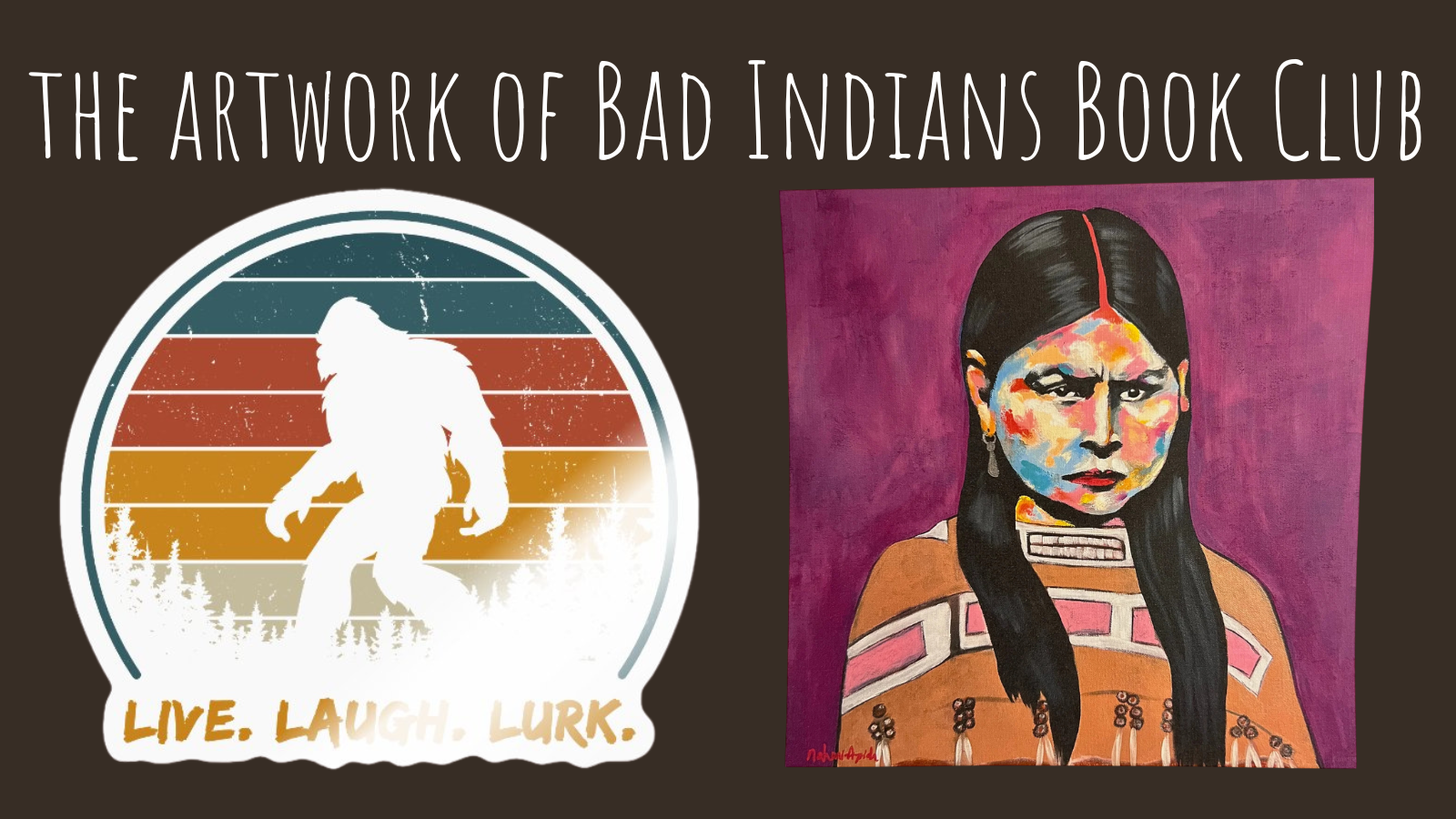
Want to add Bad Indians Book Club merch to your life? Get your Live Laugh Lurk on at Johnnie Jae's shop where she sells tshirts, stickers, tote bags and so much more. And that cover art by J NiCole Hatfield is stunning isn't it? She sells prints, cards, and more on her website.

And don't forget to join up with the Nii'kinaaganaa Foundation. Every month we collect funds from people living on Indigenous land and redistribute them to Indigenous people and organzers. You can find out more information on the website which is now powered by ghost, which means that you can become a subscriber there just like you are here! You can sign up on the website to be a monthly donor or make a one-time donation right here.